
Tennessee SAVIN Release Coverage
Tennessee’s program is the Tennessee Statewide Automated Victim Information and Notification service, or Tennessee SAVIN. It is delivered through VINELink. TDOC announced in 2022 that VINE replaced the department’s former VOICE system. For TDOC records, notices can cover location, custody-status change, facility transfer, sentence expiration, release, and parole eligibility. Registration is free and is available to victims, family members, and concerned citizens.
County-jail information also enters Tennessee SAVIN under the statewide program. Yet VINELink is not the source record. Timing and event detail depend on the jail or state custodian that supplies the data. A no-match result does not establish release. It can stem from a name variation, delayed entry, an old case, a different custodian, juvenile status, or a case outside the feed. The Tennessee research found no reliable current list of nonparticipating counties, so a failed search should not be turned into a claim that a county does not participate.
Live support is available around the clock at 888-868-4631. That number can help with use of the notification service, but it does not turn VINELink into the records office for a jail, TDOC, or a court. The source agency remains responsible for correcting its custody information and producing its formal record. When the portal and an official jail roster conflict, save the time of both checks and contact the contributing custodian. A short lag may resolve, while a transfer may require a second agency search.
The TDOC announcement for Tennessee VINE explains the state notification events and registration channels.

This image shows the TDOC agency site, not VINELink itself, and serves as the official companion route for state custody and release records.
Search Tennessee VINELink by Person
VINELink is meant for a specific person search, not a complete list of everyone recently released in Tennessee. Use the strongest identifier available. A TOMIS number is more precise than a common name. When searching by name, compare all identity and custody details that the service makes available before registering. The displayed custodian is key because a TDOC prison case and a county-jail booking leave different formal release records.
- Open VINELink and select Tennessee.
- Search by the person’s name or TOMIS number. Keep spelling and prior name forms in mind.
- Review each possible match instead of selecting the first similar name.
- Confirm the listed facility or custodian and the current custody status.
- Open the matching record and review the offered custody events before choosing notifications.
- If the person was held by a county, use the Tennessee County Directory to reach that sheriff or jail’s official record route.
The statewide FOIL system is a useful companion only when the person has Tennessee felony custody or supervision history. The TDOC Offender Search gateway describes that narrower scope.
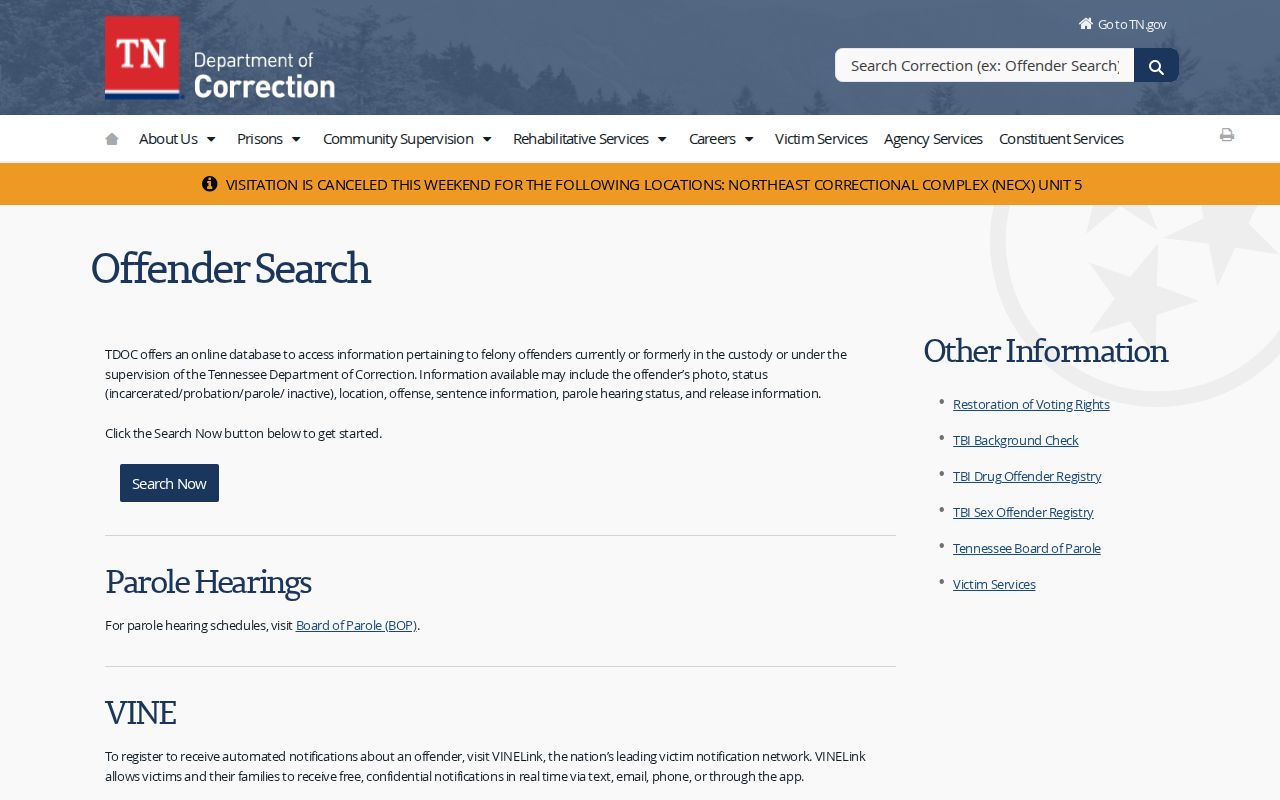
This is a FOIL screenshot rather than a VINELink screen; it shows the companion state-record path used to confirm a TDOC case.
Note: A county booking with no TDOC felony history may never appear in FOIL, even when Tennessee SAVIN receives county custody data.
Tennessee VINELink Release Fields
The exact fields shown can vary with the contributing custodian and event. Tennessee’s official description supports location, custody status, transfer, sentence expiration, release, and parole-eligibility notifications for TDOC cases. Identity or offender-number information helps distinguish records. These items should not be collapsed into one release date. Sentence expiration can occur after a person left prison on parole, and a transfer can end TDOC custody without ending physical custody.
| Field or event | What it can show |
|---|---|
| Name or offender identifier | Helps match the notification record to the correct person. |
| Custody status | Shows the status sent by the participating custodian at that time. |
| Location or facility | Identifies the contributing jail or TDOC location where provided. |
| Transfer | Signals movement between facilities or custodians, not community release by itself. |
| Release event | Reports a release event received from the source agency. |
| Sentence expiration | Marks the sentence endpoint reported through the state system, which may differ from prison departure. |
| Parole eligibility | Signals an eligibility milestone, not a Board grant or promised release. |
For a TDOC case, FOIL adds official labels such as Supervision Status, Assigned Location, Sentence End Date, Release Eligibility Date, Parole Hearing Date, and Parole Hearing Result. The FOIL detail template shows these fields.
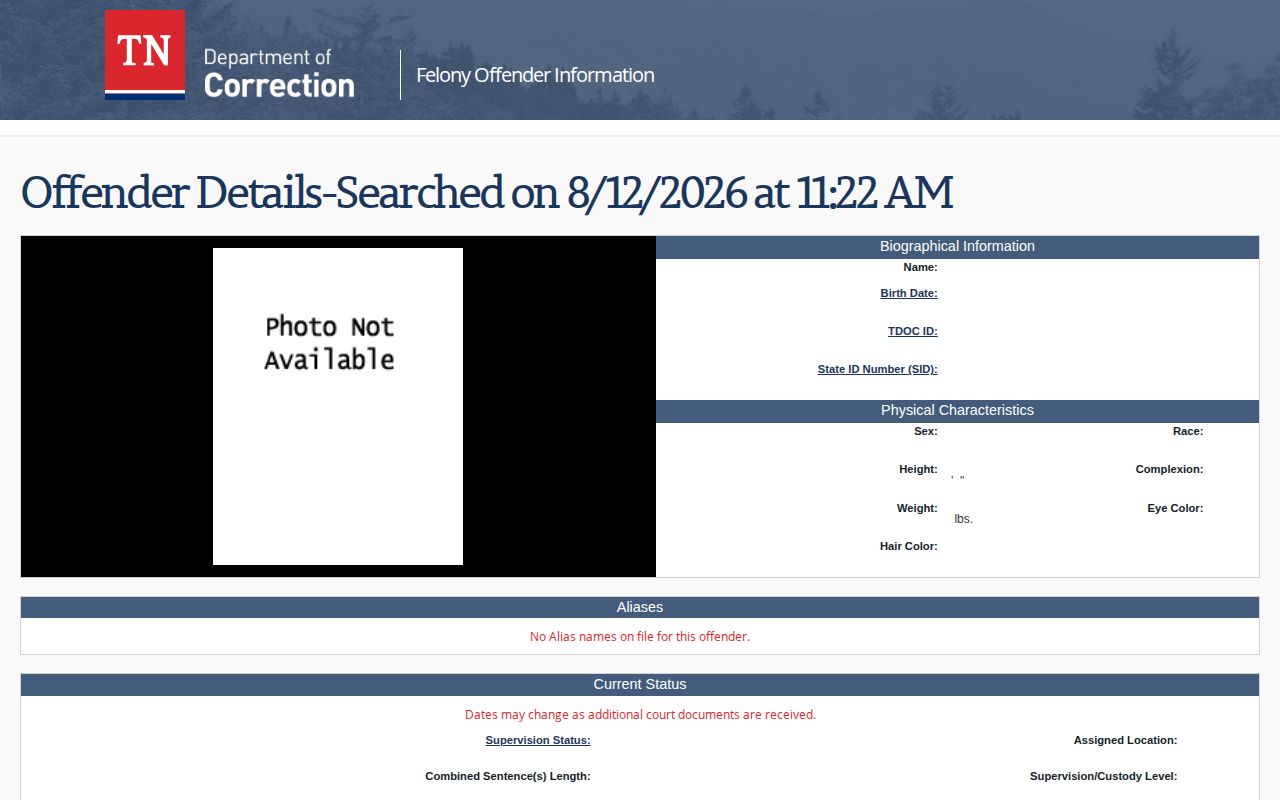
This image is the TDOC companion record, not a VINELink capture, and it helps test what the notification event means in the sentence record.
Register Tennessee Release Notifications
After confirming the correct record, choose notification channels available in the current interface. TDOC identifies phone, email, TTY, and text, and current VINELink interfaces may also offer app notices. The user should follow the on-screen verification steps for the selected channel. Tennessee SAVIN live support is available around the clock at 888-868-4631. A subscription should be kept active until the event of concern is verified with the source agency.
- Select the confirmed person record and choose notification registration.
- Select the offered events, such as release, transfer, custody change, sentence expiration, or parole eligibility.
- Enter the phone, email, TTY, text, or app contact route offered by VINELink.
- Complete any PIN or confirmation step shown for that channel.
- Save the registration details and update them if the contact route changes.
- When an alert arrives, confirm it with FOIL, the county jail, or the agency record.
Is a VINELink alert proof of release? No. It is notice of an event sent through the network. The county release record, TDOC document, or other custodian’s record provides formal verification.
Do not assume that every interface always offers every channel. Follow the current VINELink options. The state announcement is the source for Tennessee’s supported notification types, while VINELink controls the registration flow that is live at the time of use.
Registration also depends on choosing the right event. A parole-eligibility alert says the person has reached a legal milestone, not that the Board granted release. A sentence-expiration alert concerns the sentence endpoint, which may differ from the day a person left prison. A transfer alert can mean custody continues at another facility. Select more than one relevant event when the interface permits it, and keep the source identity number with the registration so a later notice can be matched to the correct record.
Tennessee Detainer Release Alerts
Tennessee has an important transfer quirk. TDOC Policy 511.03 directs a notified party to Tennessee SAVIN when a TDOC offender is released by detainer to a Tennessee county facility. In that event, “released” describes departure from TDOC custody. It does not mean the person entered the community. County custody is the next record to check.
The practical path is custodian by custodian. First, preserve the TDOC notification. Next, identify the county named in the transfer or release record. Then check that sheriff or jail’s current roster and request its later release record if the person leaves the jail. If the transfer went to federal or immigration authorities instead, Tennessee SAVIN and FOIL cannot prove the final federal outcome.
The TDOC types-of-release page helps distinguish community release and other Tennessee sentence paths.
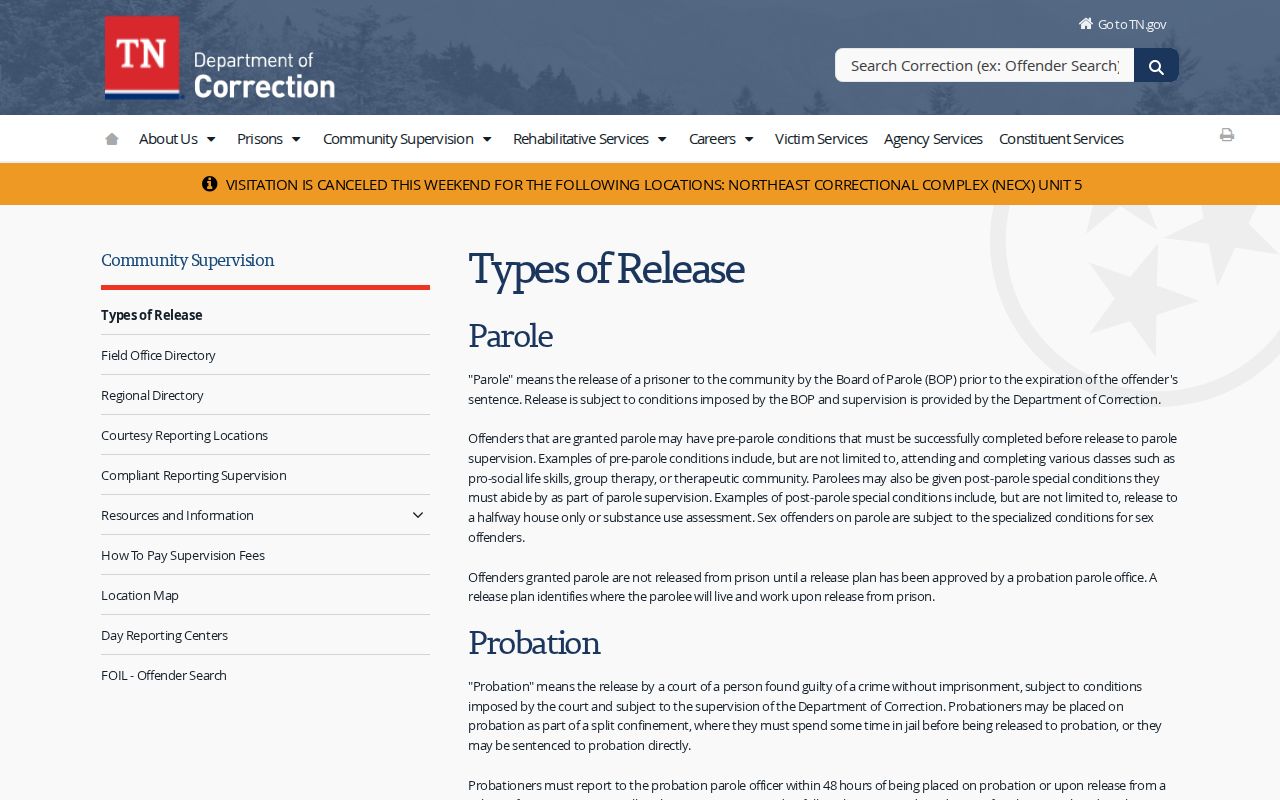
This is a TDOC companion page, not a VINELink image, and it reinforces that one agency’s release can lead to another form of custody.
Important: A Tennessee SAVIN release alert can mark transfer out of TDOC rather than release into the community.
Confirm Tennessee VINELink Releases
VINELink does not replace the record created by the agency that held the person. For a county-jail event, compare the alert with the sheriff’s roster and request the closed booking or release record. A released person may disappear from a current roster, but disappearance can also mean transfer. For a TDOC event, use FOIL and, when formal proof is needed, request the release authorization, certificate, or archived record. The broader Tennessee released-inmates search sets out the separate county, state, court, federal, and immigration paths.
Federal Bureau of Prisons custody is outside Tennessee SAVIN’s state function. Use the BOP Inmate Locator. A past release date without a federal facility can mean the person is no longer in BOP custody, but another agency or supervision term may remain. BOP says the online locator principally covers federal inmates released after 1982 and warns that First Step Act recalculations can affect projected dates.
The BOP locator screenshot below documents that separate federal path.
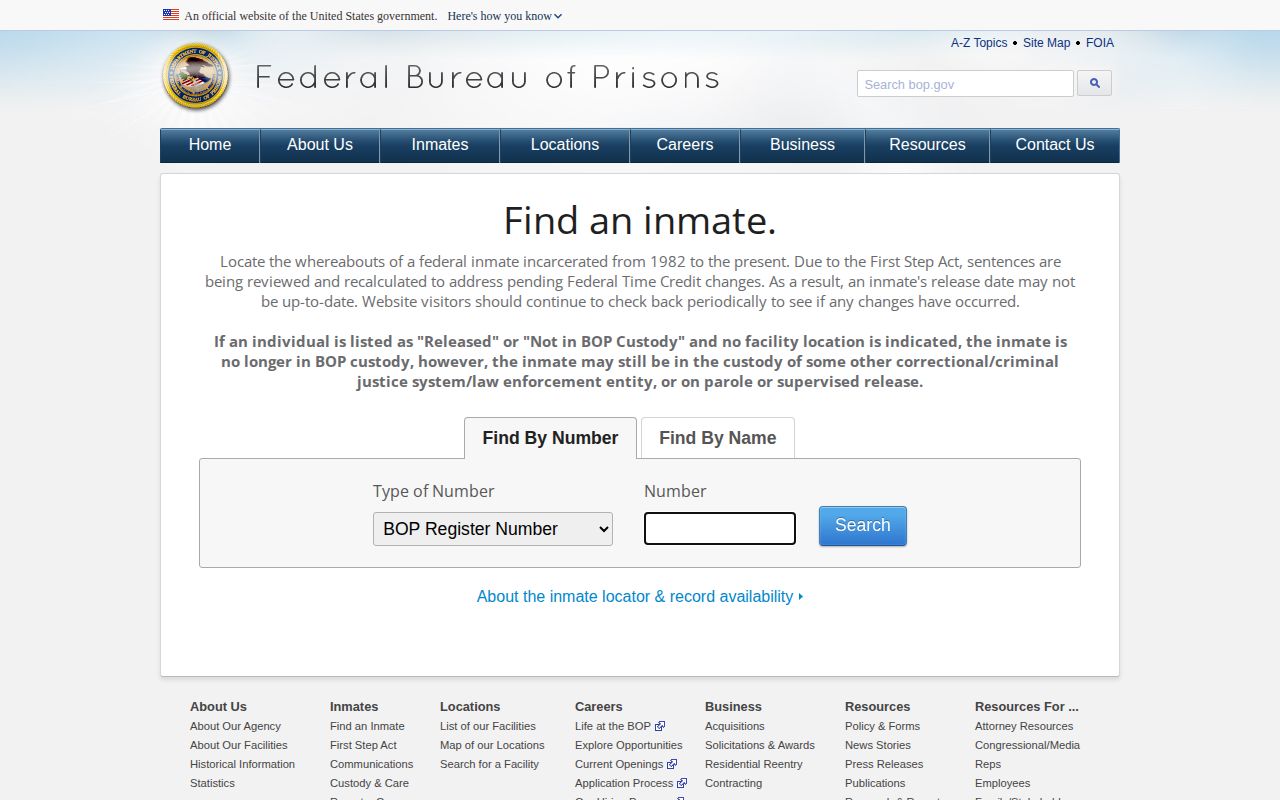
This is not a VINELink screen; it shows the federal locator required when Tennessee SAVIN is not the right system.
ICE custody also needs its own locator. ICE says its Online Detainee Locator covers people currently in ICE custody or released from ICE custody within the preceding 60 days, subject to limits. A failed result cannot prove community release. The search can use a nine-digit A-number and country of birth, or exact biographical details. No state alert should be stretched to answer a later immigration-custody question.
Note: Confirm each alert with the current custodian because data entry, transmission, and portal display can occur at different times.
Tennessee Release Proof by Custodian
A clean record trail follows the agency boundary. Tennessee SAVIN is the notification layer. FOIL is the state felony offender-information layer. A county jail owns its booking and release record. BOP and ICE maintain separate federal systems. Courts explain bond orders, judgments, revocations, and other legal events, but Tennessee’s statewide Public Case History portal covers appellate courts rather than every trial criminal case.
| Last known custody | Notification or lookup | Formal verification |
|---|---|---|
| TDOC prison or supervision | Tennessee SAVIN/VINELink and FOIL | TDOC release, sentence, supervision, or archived record |
| Tennessee county jail | VINELink where the custodian feeds SAVIN, plus the official jail system | County booking and release record |
| Federal BOP | BOP Inmate Locator | BOP record or older National Archives record as applicable |
| ICE | ICE Online Detainee Locator | ICE or ERO confirmation within the system’s limits |
| Court-ordered release | Relevant court docket | Bond order, judgment, dismissal, or trial-court disposition |
The Tennessee Public Records Act does not create a central state records warehouse. Ask the custodian that created the needed document. A precise request names the person, identifying number where known, date range, and exact record. That approach also avoids treating a notification event as though it contained every fact about the release.
For a TDOC historical record, the department’s archived-record route asks for the offender’s full name, TOMIS number, date of birth, and a detailed record description. Useful requests might name the release authorization, release date and type, sentence computation, or discharge document. For a county event, request the closed booking and release fields from that county. If the alert followed a court order, the county trial clerk may hold the bond order, judgment, dismissal, or revocation document that explains why custody changed. Each source adds a different fact, and none should be inferred from the alert alone.
A current roster and a release record also answer opposite time questions. The roster shows who the custodian lists now. The closed record shows what happened to a prior booking. Once a person drops from the current list, search the release record and transfer path. If the person appears in another custodian’s system, the first agency’s release event is evidence of movement between systems, not evidence that all custody ended.