
TDOC Released-Inmate Scope
The Tennessee Department of Correction runs the state prison system and maintains records for felony offenders who are currently or formerly in its custody or under its supervision. Its public Felony Offender Information Lookup is known as FOIL. The word formerly matters. It makes the TDOC offender search the first statewide check when a person has left a Tennessee prison, has moved from prison to parole, or has an older state felony record. The system may also include a state-sentenced person housed in a county jail. It is not a complete list of all people who have left every local jail.
A county misdemeanor case or pretrial booking may never enter the TDOC data set. In that situation, the county sheriff, jail records custodian, and trial-court clerk hold the more useful records. A person who vanishes from a current jail list may have been released, but may instead have moved to a TDOC prison, another county jail, federal custody, or immigration custody. The absence of a live jail row is therefore a clue, not proof of community release.
The official TDOC home page shows the agency-level source behind the statewide prison and supervision system.

That agency page is the starting point for current policies, official reports, prison information, and the FOIL gateway.
Use the TDOC Offender Search
Begin with the TDOC Offender Search gateway. It explains that FOIL covers felony offenders who are or were in TDOC custody or supervision. The gateway also links to the search application and companion state services. This scope statement is useful when a name appears in FOIL long after physical custody ended.
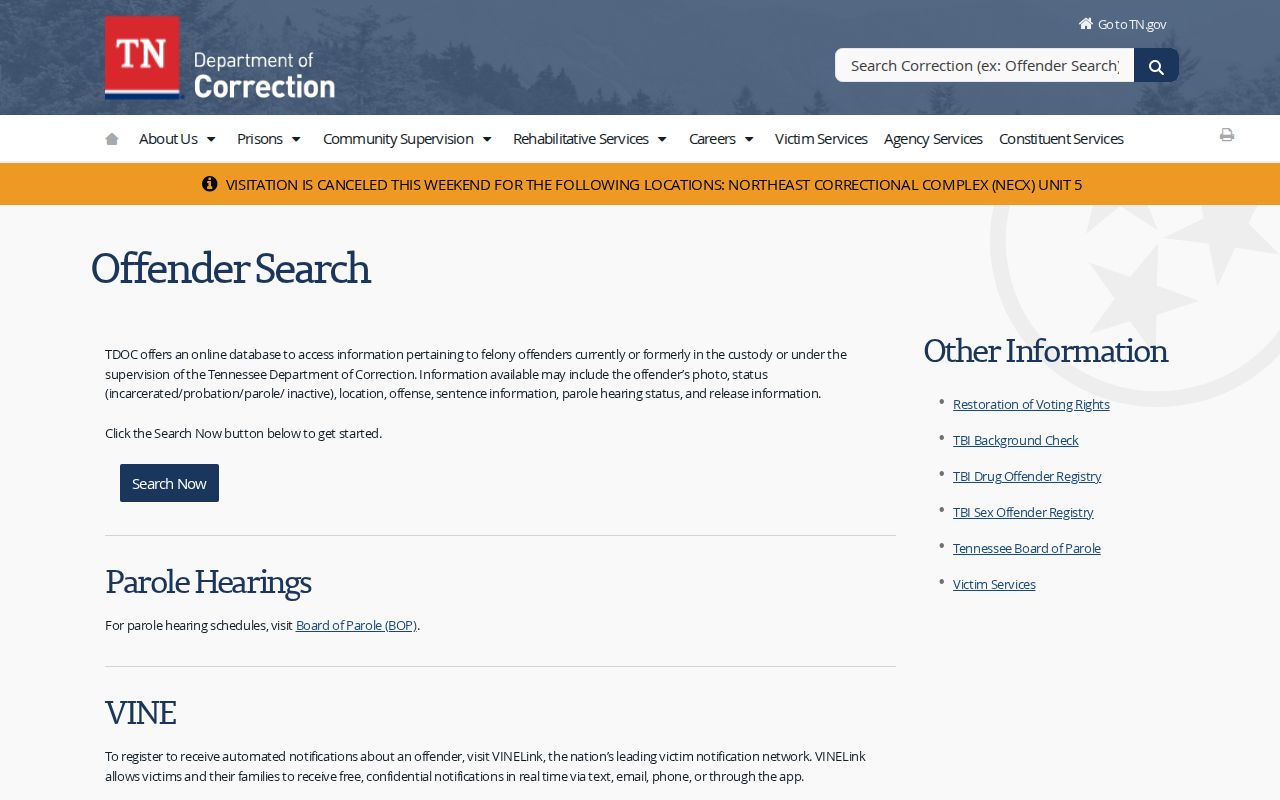
The gateway helps separate an official Tennessee felony record from a county-only booking that belongs with local officials.
Use the most stable identifier available. A TDOC or TOMIS number is stronger than a name alone. If the number is unknown, search the committed legal name, then use date of birth and other identity fields to sort common names. An alias or photo can help, but neither should replace a full identity check. FOIL says a photo may appear. It does not promise that each record has one.
- Open the TDOC gateway and follow its Search Now link to FOIL.
- Enter the TDOC or TOMIS number when known. Otherwise use the committed name.
- Open each plausible result and compare birth date, identifiers, aliases, descriptors, and photo where shown.
- Read Supervision Status with Assigned Location. Do not rely on one field alone.
- Compare the active-sentence section, sentence dates, release eligibility, and parole fields.
- Request the underlying TDOC record when formal proof is needed.
Important: An inactive TDOC status supports that no active state custody or supervision case is displayed, but it does not rule out another custodian.
Note: FOIL is also available through MyTN under Public Safety, but that app is a second interface to the same statewide subject.
Read a TDOC Release Record
A TDOC offender detail must be read as a group of related fields. FOIL does not promise a single field labeled “Release Date.” The public detail template instead separates supervision, location, sentence dates, release eligibility, parole activity, and active Tennessee sentences. That design reflects real legal differences. Eligibility is a point at which release or parole can be considered under the sentence law. Sentence end is the calculated expiration point. Neither label alone proves the day a person walked out of a prison.
The FOIL public detail template shows the exact field structure used for a Tennessee felony offender record.
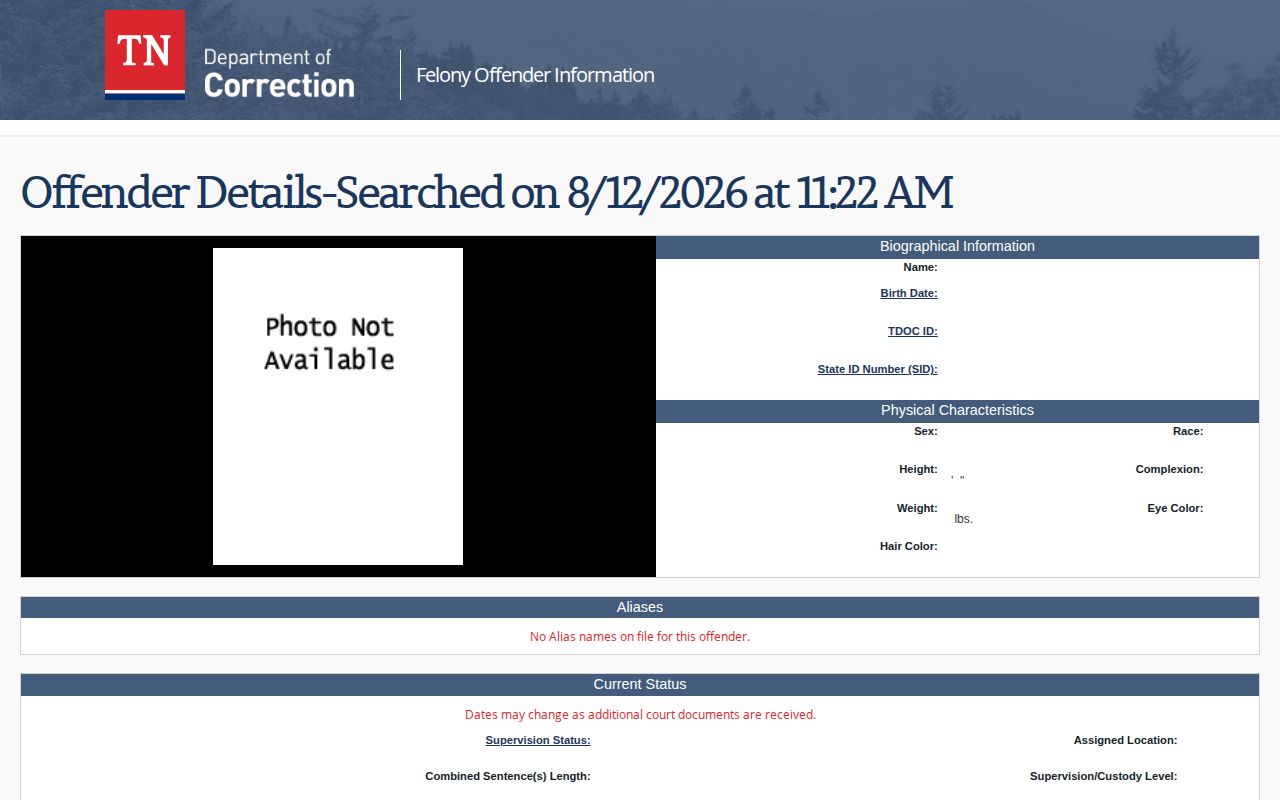
The separate date and status fields are why a released-person check needs more than a quick glance at one line.
| FOIL field | How to read it |
|---|---|
| TDOC ID / TOMIS number | The state identifier used to distinguish people with similar names and connect a record to TDOC files. |
| Supervision Status | May reflect incarceration, probation, parole, or inactive status. Parole and probation can mean community placement with active supervision. |
| Assigned Location | Adds context to status and may point to an institution or supervision assignment. |
| Sentence Begin Date | The recorded start point for the sentence entry, not a release date. |
| Release Eligibility Date | The statutory eligibility milestone. It is not a promise of physical release. |
| Sentence End Date | The calculated expiration endpoint. A person may have left prison before it under parole or another lawful release path. |
| Parole Hearing Date / Result | Shows Board activity. A grant can still require programs, an approved plan, and a certificate before release. |
| Active Tennessee Sentences | May state that no active Tennessee sentences are on file. That does not resolve county, federal, immigration, or out-of-state custody. |
FOIL warns that calculated dates can change when more court documents arrive. Former records remain within its stated scope, yet TDOC does not publish one fixed online retention period for all former-offender entries. Older files or details not shown online should be sought through the archived-record process.
The order of the date fields also matters. TDOC calculates eligibility, then certifies it to the Board when parole review applies. The Board schedules a hearing and records a result. After a grant, required steps may delay physical release. Sentence End Date continues to describe the calculated expiration endpoint. A user should therefore record the label beside each date, not copy a bare date into notes with no explanation of whether it means eligibility, a hearing, release, or expiration.
Tennessee TDOC Release Types
TDOC Policy 511.03 distinguishes release by probation, parole, mandatory parole, pardon, sentence expiration, court order, bond, and death. Those categories cannot be blended into a generic “released” label. Each answers a different question about whether confinement ended, whether the sentence continues, whether supervision follows, and whether another agency takes custody at once.
The TDOC Types of Release page gives the agency's plain-language description of parole, probation, determinate release, Community Corrections, and mandatory reentry supervision.
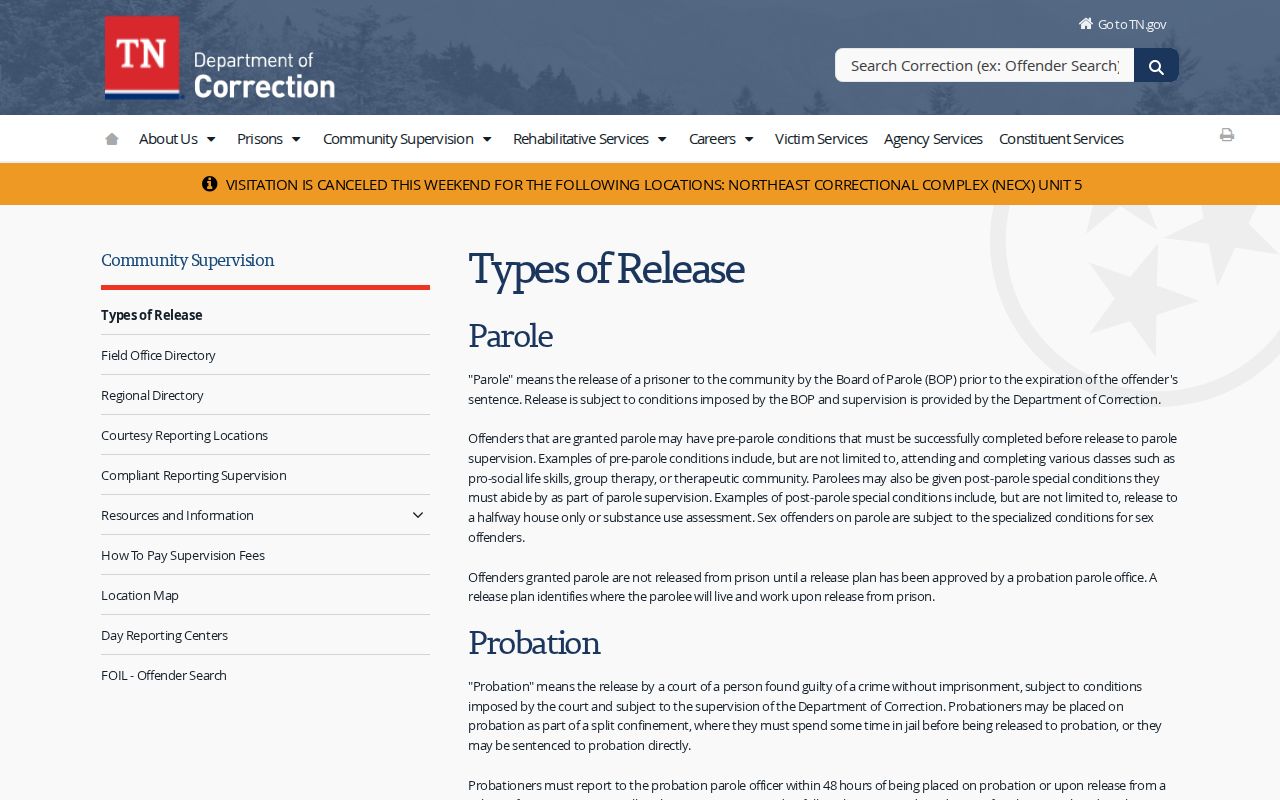
Those official categories help explain why leaving a prison and finishing all sentence authority are not always the same event.
- Parole
- Board-approved release before sentence expiration, subject to conditions and TDOC community supervision.
- Determinate release probation
- A statutory release route for a qualifying felony sentence, issued by TDOC rather than granted as Board parole.
- Mandatory reentry supervision
- A final-year supervision framework tied to qualifying felony offenses committed on or after July 1, 2021.
- Expiration
- The custodial sentence reaches its end instead of ending through a parole grant.
- Detainer transfer
- The person leaves one institution in another agency's custody, not necessarily into the community.
A parole grant is not the gate-opening event. Required programs may remain, and a probation or parole office must approve the release plan. The Board reports that the parole certificate follows those steps. A court order or bond can end confinement while the court case continues. A pardon is executive clemency, not a routine sentence calculation.
Determinate release probation has its own statutory shape. TDOC explains that it applies to a qualifying felony sentence of at least one year but no more than two years after at least 30 percent has been served. TDOC issues the certificate. Before release, notice goes to the district attorney, sheriff, and warden, and an objection requires a petition in the sentencing court. This is release to probation under the statute, not a discretionary parole grant from the Board. FOIL status and sentence fields should be read with that distinction in mind.
Mandatory reentry supervision is also narrower than the phrase “early release” suggests. TDOC states that Tenn. Code Ann. § 40-35-506 provides one year of mandatory reentry supervision for a person serving a felony sentence for an offense committed on or after July 1, 2021, subject to the statute's operation. The sentence, offense date, exclusions, calculation, and release order still control. Supervision forms part of the legal framework, so the person may have left a prison while an active TDOC supervision status remains.
Note: Tennessee release paperwork should be used to confirm the exact type, date, and authority for a specific departure.
TDOC Release-Day Records
TDOC Policy 511.03 governs the operational work behind a state-prison release. It covers sentence-management checks, release authorization, required notices, property and trust-fund handling, identification, certificates, and transportation-related steps. The safe conclusion is narrow: the institution completes a documented process before the person leaves. A roster change, a favorable hearing result, or a future date does not replace that process.
The policy's victim-release notice illustrates the useful fields. It records the offender name and TDOC ID, conviction date and county, offense, release type and date, sentence-expiration date, and intended residence at the city and state level. The form keeps release date, release type, and sentence expiration separate. Tennessee SAVIN is also named for notifications when a person is released by detainer to a Tennessee county facility.
No reliable current source reviewed states one universal public gate-money amount for every TDOC release. Property and trust-account funds are part of the official process, but a fixed sum should not be assumed. Facility pickup points, transport details, and release times can also vary with the institution and type of release.
Tennessee Release Counts Differ
The statewide numbers answer different questions. The Tennessee Board of Parole issued 2,448 parole release certificates during fiscal year 2024-25. TDOC's Statistical Abstract separately counted 11,717 people in the parole category on June 30, 2025. The first figure is a year's output of certificates. The second is the number in a supervision category on one date. Neither figure counts all departures from every state prison or county jail.
The combined supervision figure is an arithmetic roll-up of TDOC's 59,915 probation, 11,717 parole, and 3,372 Community Corrections categories. It is not an agency count of prison releases. It also shows why “released” does not always mean “finished.” Many people live in the community while a court order or TDOC supervision remains active.
Older annual material displayed smaller figures under a differently framed “community supervision by the numbers” panel. Because the reporting frames may differ, the newest Statistical Abstract should control the latest as-of totals. A year-over-year growth rate would be misleading until the table definitions are reconciled. Every Tennessee release statistic needs a date, unit, source, and agency definition.
TDOC Versus County Release Records
The TDOC offender search covers the state felony system. County sheriffs and local corrections departments keep county booking and release records. A state-sentenced person can be held in a county jail and still have a FOIL record, but that overlap does not turn FOIL into a statewide county roster. Start with the system that held the person at the time in question.
| Question | TDOC state case | County jail case |
|---|---|---|
| Typical person | Felony offender in current or former TDOC custody or supervision | Pretrial detainee, misdemeanor case, bond release, or locally held person |
| First lookup | FOIL by TDOC/TOMIS number or committed name | County jail or sheriff record system |
| Release proof | TDOC release, sentence, discharge, or archived record | Closed booking, release log, or sheriff record |
| Court source | Judgment and sentence from the proper trial clerk | Local judgment, bond order, or case disposition |
The statewide County Directory routes a county-jail question to the locality that owns the booking. If FOIL says no active Tennessee sentences, that supports a former state case only. It does not prove that county, federal, immigration, or another state's custody has ended.
Request TDOC Release Records
Use the TDOC Archived Record Request page when FOIL lacks the required detail or when a source record is needed. The page provides an online portal and a mail route to Tennessee Department of Correction, ATTN: Records Management, Rachel Jackson Building, 2nd Floor, 320 6th Avenue North, Nashville, TN 37243-0465.
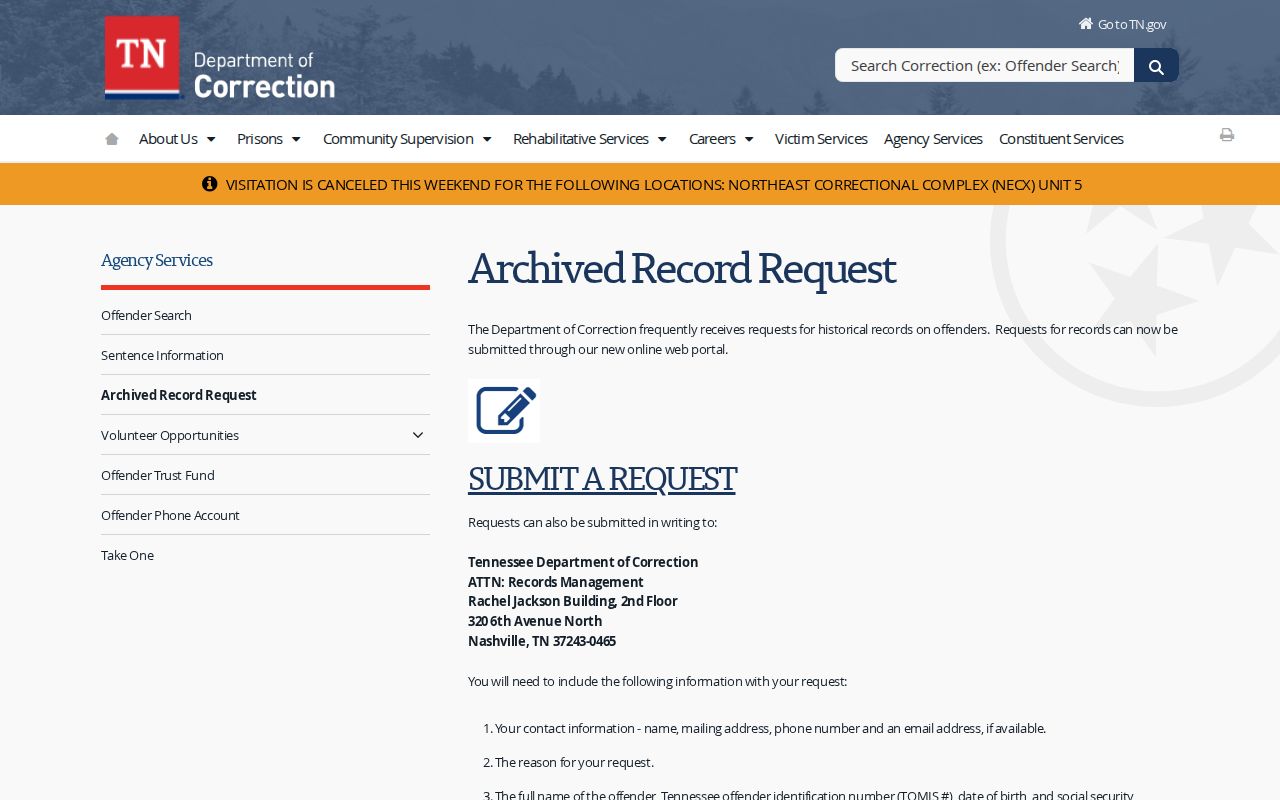
The archived-record route is the formal fallback for older offender, sentence, release, or institutional material that FOIL does not expose.
A request should give the requester's contact information, the reason for the request, and enough identity data to locate the correct file. TDOC asks for the offender's full name, TOMIS number, date of birth, and Social Security number when available, plus a detailed description of the records sought. A narrow request might identify the release authorization or certificate, release date and type, sentence-computation record, discharge document, or a dated institutional record. Questions may be directed to 615-253-8079.
- Identify the person with full name, TOMIS number, birth date, and any other available locator.
- Name the exact record, such as a release certificate or sentence-computation file.
- Give a date range and explain the request so Records Management can narrow the archive search.
- Submit through the official portal or mail route and wait for any charge notice.
Do not prepay an archive-search charge. TDOC says it will notify the requester after the search is complete if charges apply. The Tennessee Public Records Act, principally Tenn. Code Ann. § 10-7-503 et seq., is not a central records warehouse. The request must go to the actual custodian. TDOC is right for TDOC files, the Board for its hearing material, a sheriff for a county release record, and a trial clerk for a judgment or disposition.
TDOC's fiscal year 2024-25 report says its legal and records functions handled 3,943 records requests, including public-record and health-record requests. Exact identity, dates, and a defined document type can reduce needless archive work. Exemptions and lawful redactions may still limit what is released.