
Tennessee Parole Board Authority
The Tennessee Board of Parole is an independent state agency, not a branch of the Tennessee Department of Correction. Seven members appointed by the governor decide whether eligible people should receive parole. The Board can also consider revocation and rescission matters. TDOC has different duties: it calculates release eligibility, maintains prison and sentence records, prepares certain release documents, and supervises parole after release. A person may appear in both agencies’ records because each system answers a separate part of the case.
The Board’s Parole Hearings Division publishes the statewide calendar route and explains how a hearing officer gathers facts and makes a nonbinding recommendation.
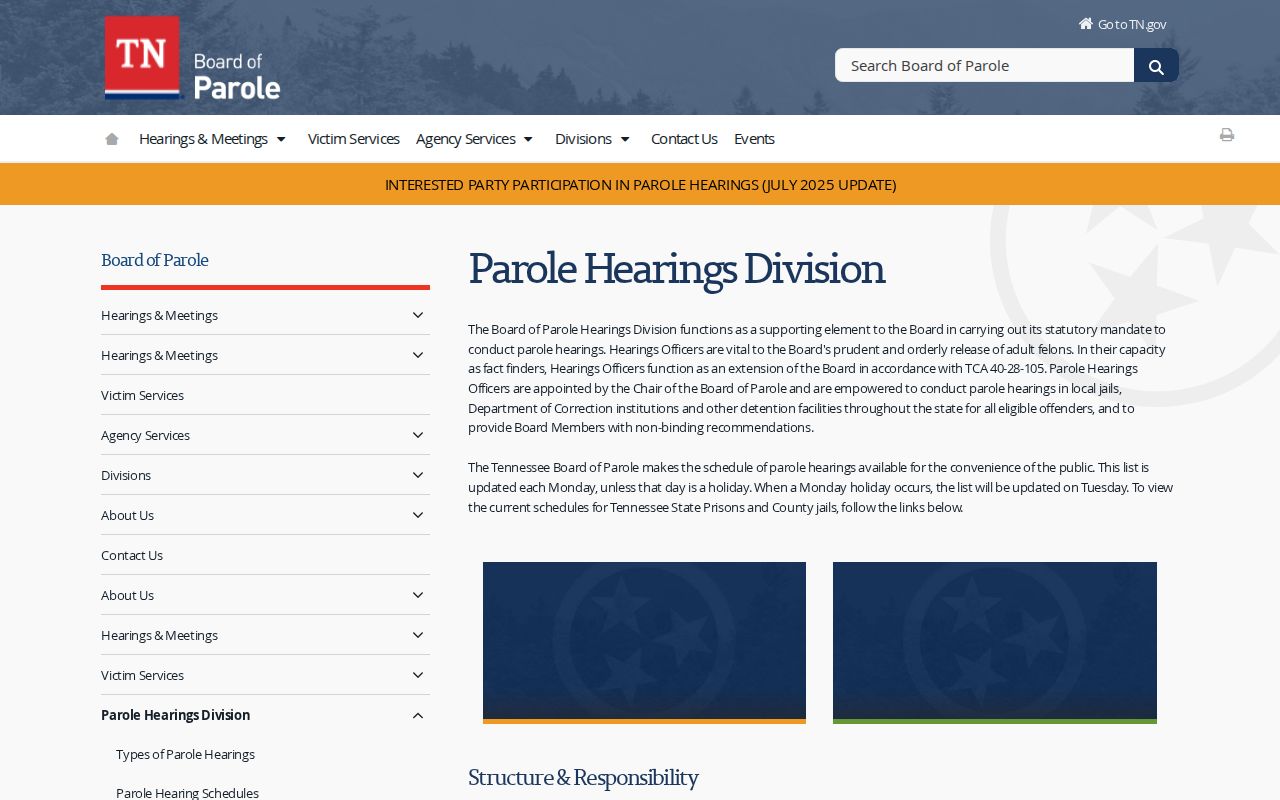
This official hub is the starting point for both state-prison and county-jail parole dockets.
A hearing officer’s recommendation is not the final action. Board members can adopt, change, or reject it. The Board says some conviction offenses require three concurring votes, most violent conviction offenses require four, and two votes are needed to revoke parole. Those voting rules explain why an event on the schedule cannot be read as an outcome.
The Board reports that its review can include the seriousness of the offense, time served, a risk and needs assessment, institutional conduct, victim input, and statements from the person and other interested parties. Its governing criteria are also set out in Board Rule 1100-01-01-.07. These are decision factors, not a formula that lets a portal user predict an outcome. The hearing officer may review social and criminal history, prior supervision, program participation, revocation evidence, and a proposed release plan. The official result is still the Board action shown in the case record.
Find Tennessee Parole Hearing Dates
The public calendars are divided by custody setting. One schedule covers Tennessee state prisons. Another covers county jails holding people whose parole cases are before the Board. Docket rows identify the facility, TDOC number, person, hearing type, and date. The Board says schedules are refreshed each Monday, or Tuesday when Monday is a holiday. Because a docket can change, the posted date should be checked again close to the event.
- Open the Board’s Parole Hearings Division hub rather than relying on an old saved schedule.
- Choose the state-prison schedule or the county-jail schedule.
- Match the full name and TDOC number. Use the facility and hearing type as added checks.
- Record the hearing date and type, but treat the entry as a prospective calendar item.
- Verify a change with the Board at 615-741-1150, the schedule contact listed by the agency.
The hearing type matters. Official schedules can list an initial parole hearing, parole review, revocation, rescission or pre-parole matter, and other custodial proceedings. A revocation hearing for someone already on parole is not a first request to leave prison. A rescission matter can arise before a planned release. Reading the type prevents a calendar row from being mistaken for a new grant hearing.
Note: Tennessee parole calendars are working schedules, so confirm the date even when the name and TDOC number match.
Find Tennessee Parole Decisions
The Board site did not provide a separate public decisions database in the official pages reviewed. Tennessee instead splits the public result path. The schedule shows what is set. FOIL, TDOC’s Felony Offender Information Lookup, exposes person-level fields labeled Parole Hearing Date and Parole Hearing Result. Once the Board acts, the person and registered interested parties receive direct notice. Board Operations holds the underlying hearing record and fulfills public requests for those files.
The official FOIL detail template shows where the hearing date and result sit beside sentence and supervision fields.
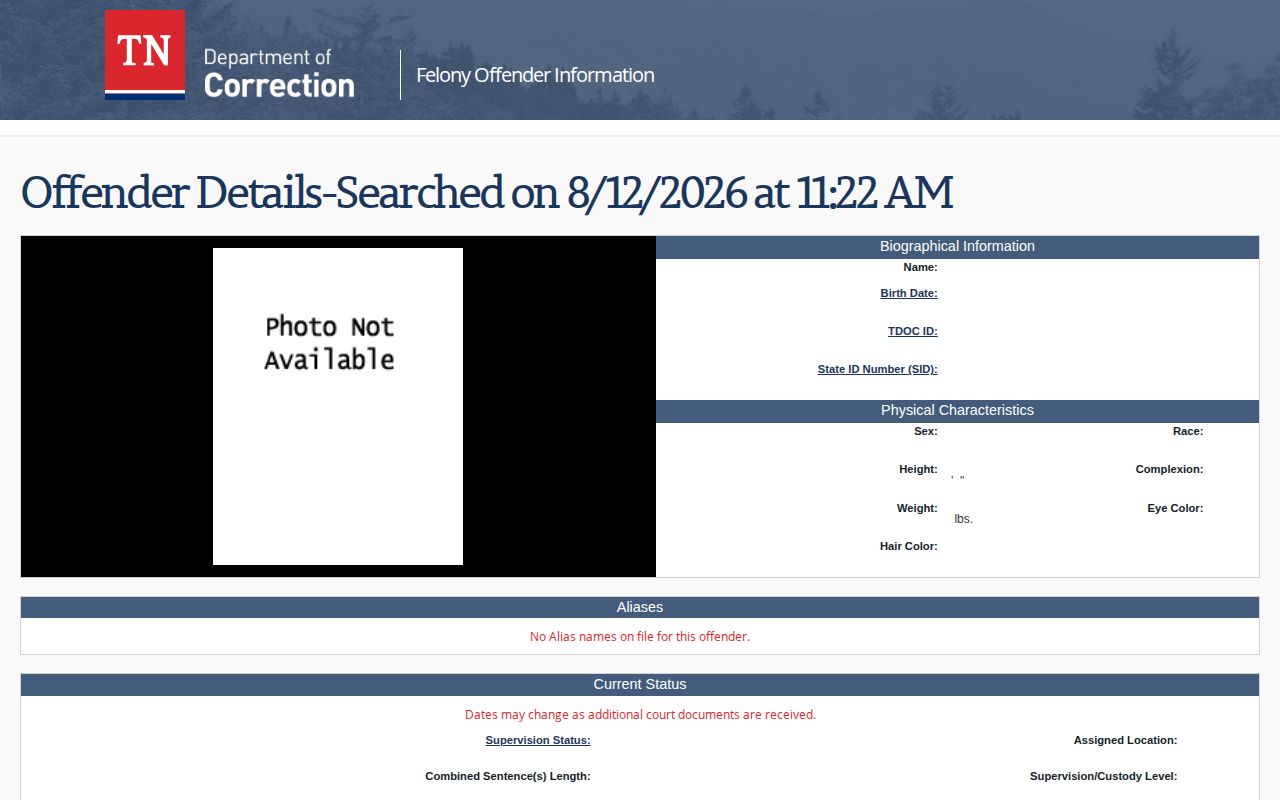
That layout helps distinguish a hearing result from the later certificate and physical release event.
- Search FOIL by TDOC/TOMIS number when possible, or use the committed name and birth date.
- Compare identity fields before opening a result. Do not rely on name alone.
- Read Parole Hearing Date and Parole Hearing Result together with Supervision Status and Assigned Location.
- For the signed or complete decision record, ask Board Operations for the hearing file using a narrow identity and date range.
- Check TDOC status later if the result is a grant, since release-plan approval and certification still follow.
The deeper TDOC Offender Search page explains how the same FOIL record separates parole eligibility, sentence end, active sentences, and current supervision. Those fields should be read together when the question is whether the person actually left custody.
Direct notice has its own role. The Board reported registering 254 more victims and family members for hearing, decision, and release notifications during FY 2024-25. That measure describes new registrations, not the full number receiving notice. A person who needs ongoing event alerts can also use Tennessee SAVIN, while the Board file remains the source for the decision itself. The split prevents one system from being asked to perform every function: the schedule sets the event, FOIL displays a public result field, notice informs registered parties, and the Board preserves the hearing record.
Tennessee Parole Hearing Outcomes
Not every docketed event ends with release. A grant moves the case to a new stage. A denial generally leads to a later review date. A continued or deferred matter awaits more time, information, or action. A rescission can withdraw a prior grant before release. The precise language in the FOIL result and Board record controls, so a general outcome label should not replace the case document.
| Outcome | Meaning | What comes next |
|---|---|---|
| Granted | The Board approved parole, subject to remaining requirements. | Required programs, release-plan approval, certificate issuance, then release to TDOC supervision. |
| Denied | The Board did not approve release at that review. | A later review date is set, generally no more than six years later in most cases. |
| Deferred or continued | The matter was not finally resolved at the listed event. | Check the revised schedule, FOIL result, and direct Board notice. |
| Rescinded | A prior grant was withdrawn before release. | The person remains in custody unless another valid release path applies. |
| Revoked | Parole was ended after a violation process. | Custody and later review depend on the final Board action and sentence record. |
Important: “Granted” is not the gate date. The Board reports that programs and an approved release plan can precede the parole certificate and physical release.
Tennessee Parole Release Eligibility
Tenn. Code Ann. § 40-35-501 is the central release-eligibility statute. It does not create one percentage for every case. Sentence class, offense, offense date, and special provisions can set different thresholds, including offense-specific service rules. TDOC is the official timekeeper. It certifies eligibility to the Board, which then conducts the decision process. Eligibility opens review but does not grant a right to release.
The TDOC types-of-release page shows how parole fits among other Tennessee release paths.
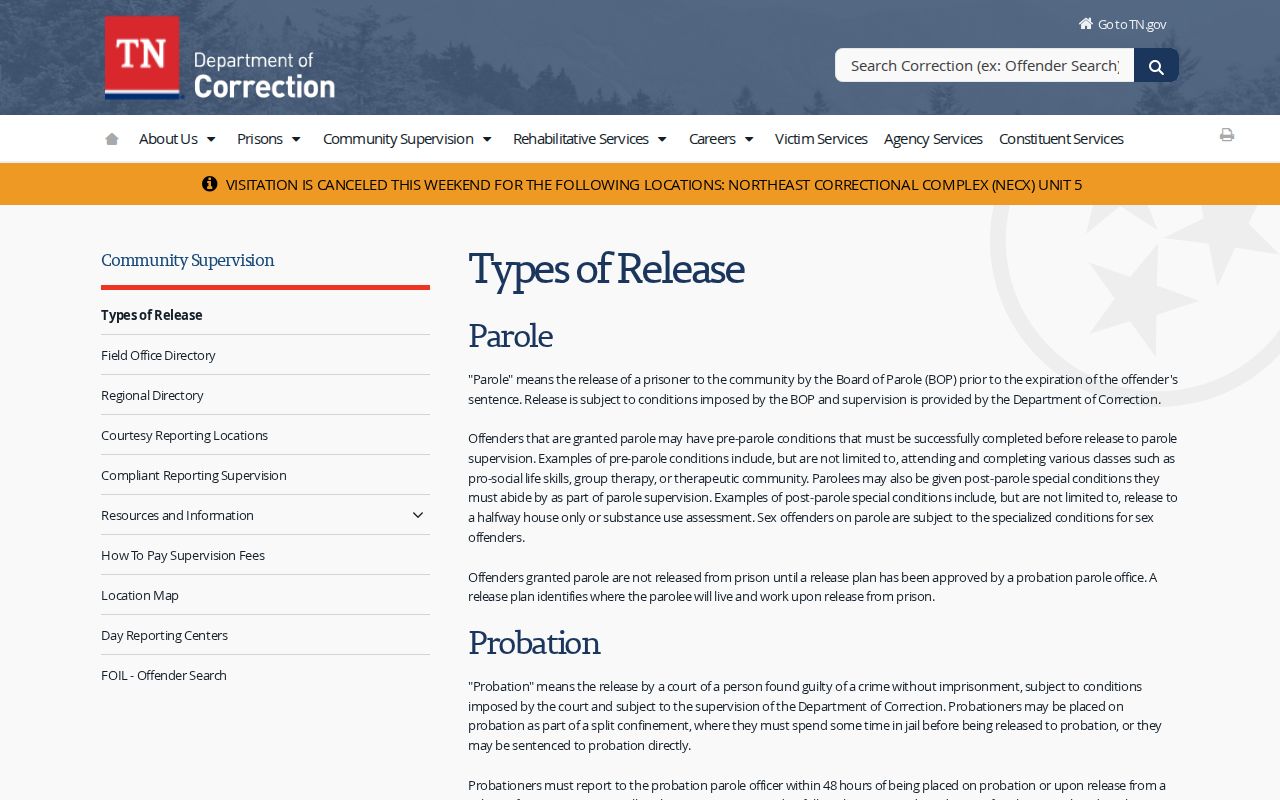
This state source also helps keep a Board parole grant separate from determinate release probation, mandatory reentry supervision, and sentence expiration.
FOIL labels the forward-looking field Release Eligibility Date, not a guaranteed release date. Its Sentence End Date is a separate calculated endpoint. A favorable hearing result is another milestone. The safe sequence is sentence calculation, eligibility certification, hearing and decision, required conditions, release-plan approval, certificate, and release. New court documents can also change FOIL dates. The date should never be recalculated from a sentence length alone.
Note: Eligibility, a grant, certificate issuance, and physical release are four different Tennessee parole events.
Tennessee Parole Appeals and Records
A denial, revocation, or rescission can enter the Board’s appeal-review process under Tenn. Code Ann. § 40-28-105(d)(11). The Board reported receiving 736 appeal applications in FY 2024-25. That number describes applications, not successful appeals or releases. A person seeking the status of one case should use the Board file and notice, not draw a conclusion from the annual total.
The Board’s annual report says Board Operations handled requests for hearing records. Tennessee’s public-records framework has no one central records warehouse. A request should therefore identify the person, TDOC number, hearing date, type of record, and a useful date range. TDOC remains the custodian for its sentence and release records. The Board is the proper source for the hearing file. A county clerk holds the trial judgment or order when that document affects the sentence.
The Tennessee Public Records Act is principally codified at Tenn. Code Ann. § 10-7-503 et seq. It directs a requester to the actual custodian and allows exemptions or redactions where law protects material. For a hearing matter, ask the Board for the decision, recording, recommendation, or other identified hearing material that is needed. For sentence computation, eligibility certification, release authorization, or archived offender material, ask TDOC. Naming the desired record and hearing date makes the request more useful than asking for all records associated with a person.
The TDOC archived-record request page illustrates the separate route for historical offender, sentence, or release documents.
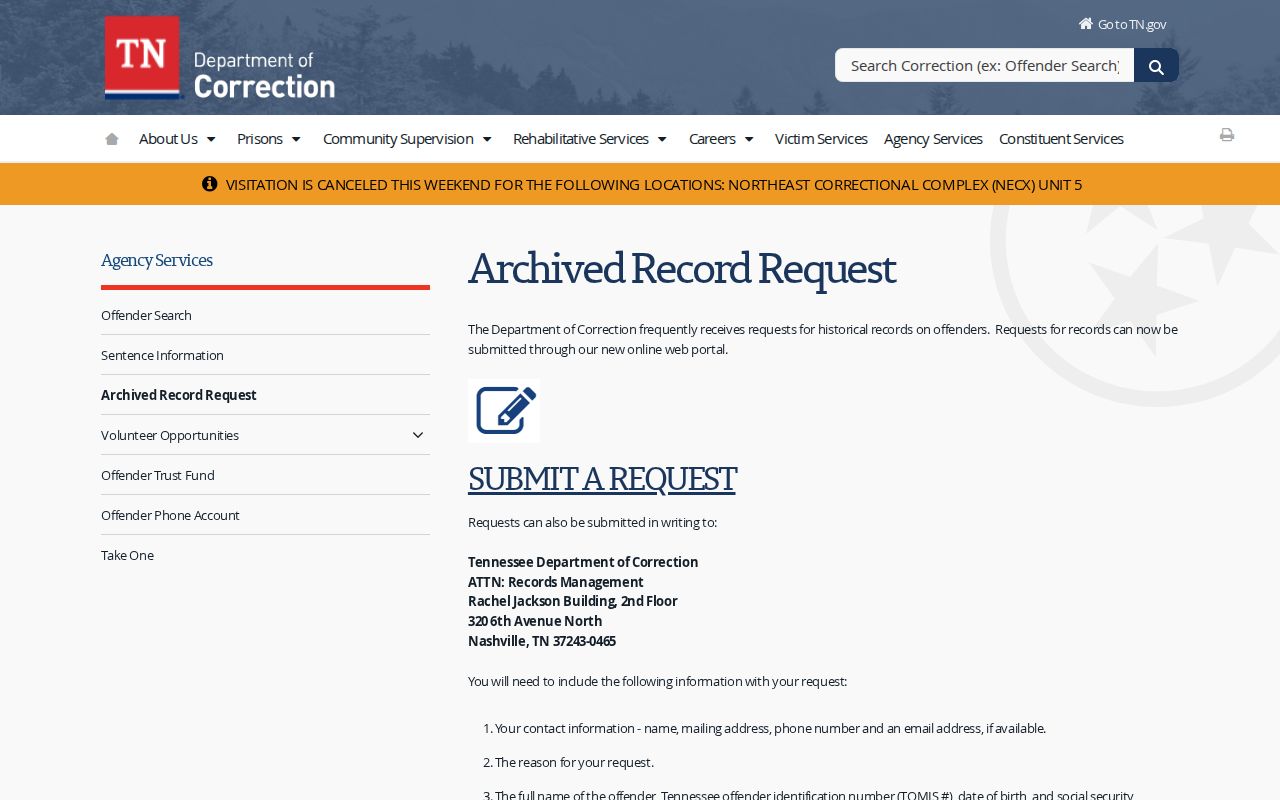
Use that TDOC route for TDOC-held material, while sending the hearing-record request to the Board that created it.
Tennessee Clemency Is Not Parole
Executive clemency is a separate state path. Only Tennessee’s governor may grant a commutation, pardon, or exoneration. The Board screens applications, may hold a clemency hearing, and sends a nonbinding recommendation. It does not grant clemency. A pardon after sentence completion is therefore not a parole result and should not be searched as though it came from an ordinary eligibility hearing.
In FY 2024-25, the Board received 432 clemency applications: 240 commutations, 173 pardons, and 19 exonerations. It found 184 applications met initial screening criteria and held 34 clemency hearings. These are workload figures. They are not counts of people released, and a hearing does not establish that the governor granted relief. The final executive action and Board recommendation must remain distinct in the record.
- Parole
- A Board decision allowing conditional community release before sentence expiration.
- Commutation
- Executive clemency that changes a sentence when granted by the governor.
- Pardon
- An act of executive clemency, often sought after the sentence, that is not a parole discharge.
- Exoneration
- A separate clemency category reviewed by the Board and decided by the governor.
Tennessee’s Three Parole Channels
Tennessee divides public parole information among three channels. Calendars are refreshed on Monday, or Tuesday after a Monday holiday. FOIL supplies the person-level Parole Hearing Result. The Board sends the actual decision to the offender and registered interested parties, while its file is the route for the underlying record. No separate official public Board decisions database was documented in the reviewed sources.
Use each channel for its intended time frame. The calendar looks forward and can change. FOIL offers a public result field after action. Direct notice and the Board file document the decision. For what happens after a grant, Tennessee’s Parole / Probation page covers TDOC community supervision and the field-office route. A person can leave prison on parole while the sentence and supervision remain active.
Note: Match the TDOC number across the calendar, FOIL detail, and Board record to avoid confusing people with similar names.