
Tennessee Parole and Probation
Parole, probation, and Community Corrections can all place a person in the community under rules, but they begin in different ways. The Tennessee Department of Correction types-of-release page defines parole as release granted by the Tennessee Board of Parole before the sentence expires. A court orders probation, often instead of prison or after a split term of confinement. Community Corrections is a statutory, community-based sentencing alternative for qualifying nonviolent felony cases. TDOC supervises all three categories through its Community Supervision operation, while the Board decides parole and has no role in granting probation.
The official TDOC page below places these forms of release in one state framework.
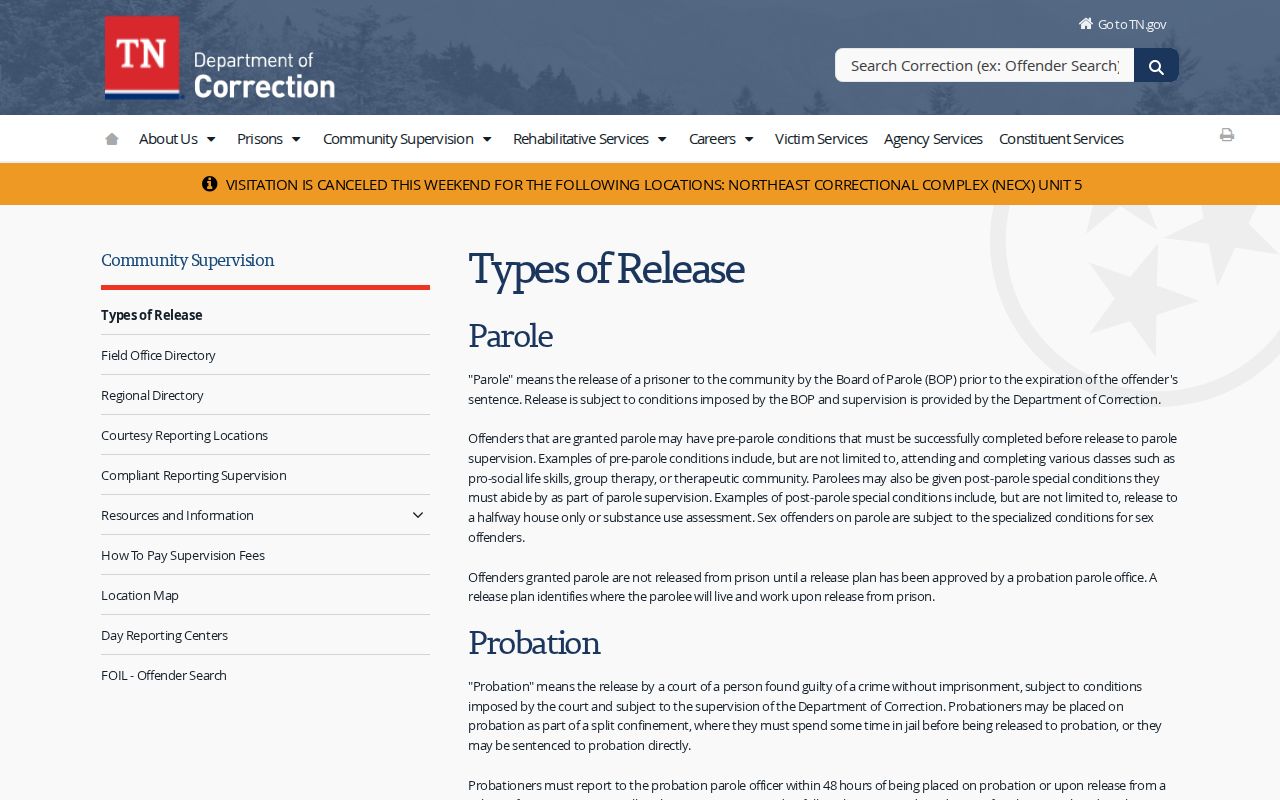
Its categories help identify which order, agency, and end-of-supervision record should be checked.
Two other Tennessee terms can affect the record without becoming ordinary Board parole. Determinate release probation can apply to a qualifying felony sentence of at least one year but no more than two years after the statutory service point. TDOC issues that certificate, and the sentencing court can become involved if a notified official objects. Mandatory reentry supervision is a final-year framework tied to qualifying felony offenses committed on or after July 1, 2021. It should not be summarized as an automatic early release. The offense date, sentence, statutory operation, and release document control. Both paths show why the name of the release type matters when verifying supervision.
| Supervision type | How it begins | Best proof |
|---|---|---|
| Parole | The Board grants release before sentence expiration, followed by plan approval and a parole certificate. | FOIL status, Board result, and the parole certificate or Board file. |
| Probation | The sentencing court orders community supervision. | Court order or docket, FOIL status where listed, and the TDOC supervision record. |
| Community Corrections | A court imposes a qualifying community-based felony sentence. | Sentencing order and TDOC Community Supervision record. |
- Parole
- Conditional release from prison before the sentence ends.
- Probation
- A court-ordered sentence served in the community under stated terms.
- Discharge
- The formal end of the supervision authority shown by the controlling order or agency record.
- Inactive
- A FOIL status indicating no active TDOC custody or supervision case is displayed, subject to other records.
Verify Tennessee Post-Release Supervision
The statewide starting point is Felony Offender Information Lookup, or FOIL. It covers Tennessee felony offenders who are currently or formerly in TDOC custody or supervision. That scope makes it useful after a state-prison release. It is not a full list of all people on county misdemeanor probation, all pretrial cases, or all federal supervision. Search the committed name and date of birth with care, or use a TDOC/TOMIS number when known. Then read Supervision Status and Assigned Location together. A parole or probation status can mean the person lives in the community while TDOC authority remains active.
The TDOC Offender Search gateway explains the scope of FOIL and links the official lookup.
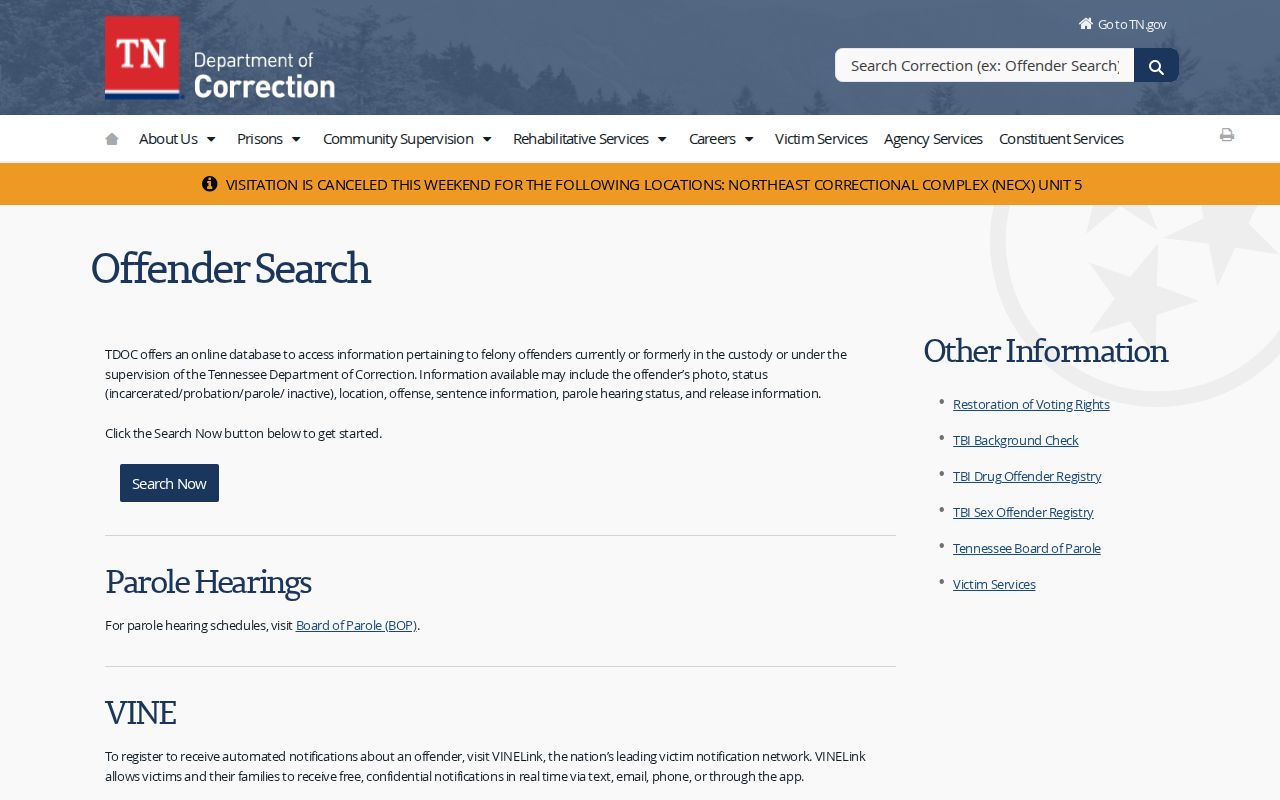
This gateway is useful when a name search must be checked against TDOC’s own description of the database.
- Open FOIL through the TDOC gateway and search by TDOC/TOMIS number when it is known.
- For a name search, compare the birth date, TDOC ID, SID, aliases, photo, and other identity fields before choosing a match.
- Read Supervision Status and Assigned Location. Do not treat a blank or unexpected location as proof of absconding.
- Use the TDOC Community Supervision office locator to identify the official district or field-office route.
- For parole, compare the FOIL hearing result with Board records. For probation, check the sentencing court’s order through the appropriate county clerk.
- For proof that supervision ended, request the discharge or completion document from the agency that holds it.
Important: A person may be outside prison and still have active Tennessee parole, probation, or Community Corrections supervision.
Note: FOIL is a lead for state felony supervision, while the court order remains central to a Tennessee probation case.
Tennessee Supervision Agency Roles
The Tennessee Board of Parole and TDOC have separate roles. The Board is an independent seven-member state agency. It rules on parole grants and revocations and reviews clemency requests. TDOC calculates sentence dates, runs prisons, issues some release certificates, and supervises parole, probation, and Community Corrections in the field. Mixing those roles can send a record request to the wrong office. A parole hearing file belongs with the Board. A field-supervision record belongs with TDOC. A probation judgment belongs with the sentencing court.
The Tennessee Department of Correction home page is the official statewide agency entry point.

From that agency path, users can reach Community Supervision, FOIL, policies, and state records services.
Statewide supervision contacts
TDOC Community Supervision
Use the official office locator to choose the district or field office tied to the case.
Find a Community Supervision office
Tennessee Board of Parole
Use Board Operations for parole hearing and decision records.
Tennessee Board of Parole
A single Nashville contact is not a substitute for the assigned office. Tennessee supervision is organized across districts and field offices, so the locator is the sound statewide route. When a probation term comes from a county court, the county clerk can supply the order that sets its length and terms. The Tennessee County Directory routes a county-specific release or court question to the right locality.
Interstate movement adds another check. A person can be supervised in another state under a compact arrangement while the Tennessee sentence remains the source case. The assigned office should confirm the receiving jurisdiction and current reporting route. FOIL’s Assigned Location may help, but it should not be treated as a statement of physical custody. For any dispute, request the record from the agency responsible for the specific part of supervision rather than asking one office to certify every part of the case.
Tennessee Supervision Status Changes
Conditions are the rules attached to parole, probation, or Community Corrections. A reported violation does not itself prove revocation. For parole, the Board can consider revocation after the required process. Probation action turns on the court and its orders. An absconder is a person alleged to have stopped reporting or left supervision without permission, but that label must come from an authorized record. No official statewide public TDOC absconder or warrant list was found in the Tennessee source sweep.
Do not infer a warrant from a missing name, an old Assigned Location, or an inactive FOIL entry. Court and law-enforcement records control warrant status. The relevant clerk or agency can confirm which public channel applies, although no public search should be described as a complete statewide warrant system. If the concern is a custody or release change rather than a warrant, Tennessee SAVIN through VINELink may provide an alert. Its notice is still not the formal violation or revocation record.
Does “inactive” mean supervision ended? It is a useful TDOC indicator, but formal proof comes from the discharge, completion certificate, sentence record, or court order. Other state, county, federal, or immigration custody can also exist.
Note: Verify a claimed violation with the court, Board, or assigned TDOC office instead of drawing a conclusion from portal silence.
Tennessee Supervision Discharge Records
Parole commonly continues through the remaining sentence unless it is discharged under law. Probation ends under the sentencing order and court authority, with TDOC maintaining supervision records where it served as the supervising agency. Sentence expiration can end ordinary sentence authority, but it must not be assumed from a prison departure date. Tennessee also has Community Supervision for Life in certain cases. The Board reports that a person can have fully served the sentence yet remain under TDOC officer supervision due to the offense, without the Board having released that person.
The clean verification chain is status, source order, and formal end document. FOIL can show inactive or no active Tennessee sentences. The court docket can show the probation order and later action. TDOC or the Board can hold the certificate or case record. A narrow request should name the person, date range, and exact record sought. The statewide Tennessee released-inmates search path explains how county, TDOC, court, and federal records differ when the question extends beyond supervision.
For older TDOC material, the archived-record process accepts an online request or mail request to Records Management. TDOC asks for requester contact information, a reason, the person’s full name, TOMIS number, date of birth, and a detailed description of the record. The department says not to prepay an archive-search charge because it will provide notice after the work is complete. Ask for a discharge certificate, completion record, parole certificate, or defined supervision record by name when that is the document needed. A broad request for an entire file is less precise and may obscure the one date or status at issue.
The FOIL detail template shows the state fields used to separate current supervision from sentence and hearing data.
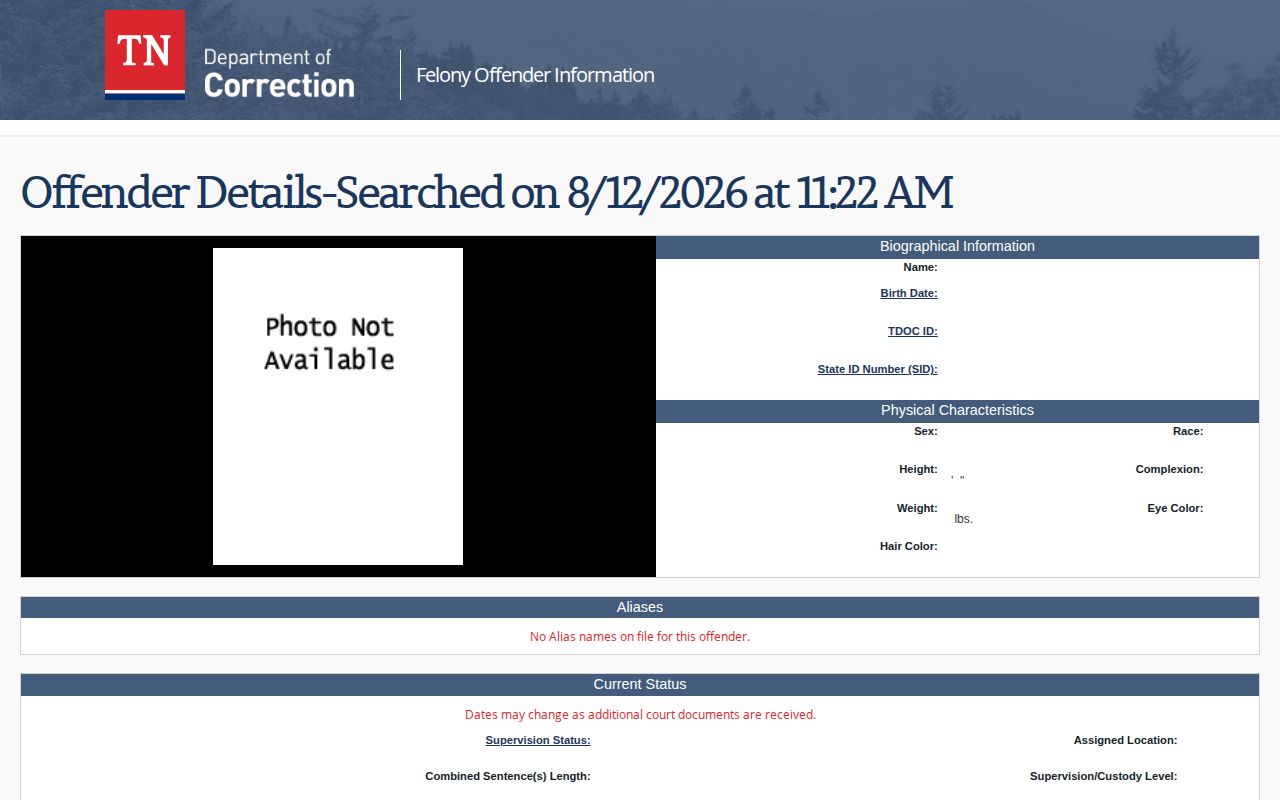
Those fields are best read as a set, not as one stand-alone claim that all supervision has ended.
Tennessee Supervision Counts Explained
TDOC’s FY 2024-25 Statistical Abstract reports the statewide position on June 30, 2025. It lists 59,915 people on probation, 11,717 on parole, and 3,372 in Community Corrections. Together, those published categories total 75,004 cases. That sum is a roll-up of three categories, not a separate TDOC headline and not a count of people released during the year. It shows why “released” does not always mean “finished.” Many people live outside a prison while a court or TDOC still supervises them.
Counts must retain their date and category. A yearly count of parole certificates measures new certificate output. An as-of count measures the number under supervision on one day. Neither represents all prison and jail releases in Tennessee. When verifying one person, the case-level FOIL result and source documents matter more than the statewide totals.
The Board issued 2,448 parole release certificates during FY 2024-25. That annual output should not be compared as though it were the same measure as 11,717 parole cases on one date. One counts certificates issued across a year; the other counts an active supervised population at a set point. Both figures require their agency definition.
Tennessee Community Resource Centers
TDOC operates seven paired Day Reporting Center and Community Resource Center sites. The distinction matters. Day Reporting Center participation is tied to active community supervision and requires at least 18 months remaining, according to TDOC. Community Resource Center services are also open to a person released after sentence expiration. This statewide access point is broader than a parole-only program, yet it should not be used to infer that a named person is supervised.
The TDOC Day Reporting and Community Resource Center page is the official source for current locations and access details. Because these centers and their offerings can change, the agency page should control rather than an old list copied into a record. Their presence adds a navigation route after release, but the supervision office locator remains the right tool for identifying the field office assigned to an active case.
Note: Community Resource Center access after sentence expiration does not, by itself, show parole, probation, or active TDOC supervision.