
Tennessee Release Paths Explained
A Tennessee release starts with the custodian, not with one statewide list. County sheriffs and local corrections offices process bond, time-served, dismissal, and other local jail departures. The Tennessee Department of Correction (TDOC) processes releases from state institutions and privately managed state prisons. A federal prison or immigration detention departure belongs to a separate federal system. State-sentenced people can also be held in county jails, so the building alone does not always reveal which agency owns the sentence record.
Release does not always mean freedom in the community. A person may leave one jail on transfer to TDOC, another county, the Federal Bureau of Prisons, or U.S. Immigration and Customs Enforcement. Parole ends prison confinement but continues the sentence under supervision. Expiration reaches the sentence endpoint. A court order, bond, pardon, determinate release, or detainer transfer has its own legal effect and record trail.
| Release Path | Meaning and Next Record |
|---|---|
| Bond or court order | Confinement ends under court authority; check the county booking and trial-court file. |
| Time served or dismissal | The local jail closes custody; the sheriff and court clerk keep separate parts of the event. |
| Parole | Prison confinement ends before sentence expiration; FOIL and TDOC supervision remain relevant. |
| Determinate release probation | A qualifying short felony sentence moves to statutory probation, not Board-granted parole. |
| Mandatory reentry supervision | A qualifying final sentence period is served under supervision rather than treated as full discharge. |
| Sentence expiration | The TDOC sentence reaches its endpoint; FOIL and release paperwork document the state case. |
| Detainer transfer | One custodian releases the person to another; check the receiving county, federal agency, or ICE. |
The official TDOC home page shows the state agency that manages prison custody and community supervision.

That statewide role must still be separated from the county sheriff records that document local bookings and releases.
The TDOC types of release page defines parole, probation, determinate release, Community Corrections, and mandatory reentry supervision.
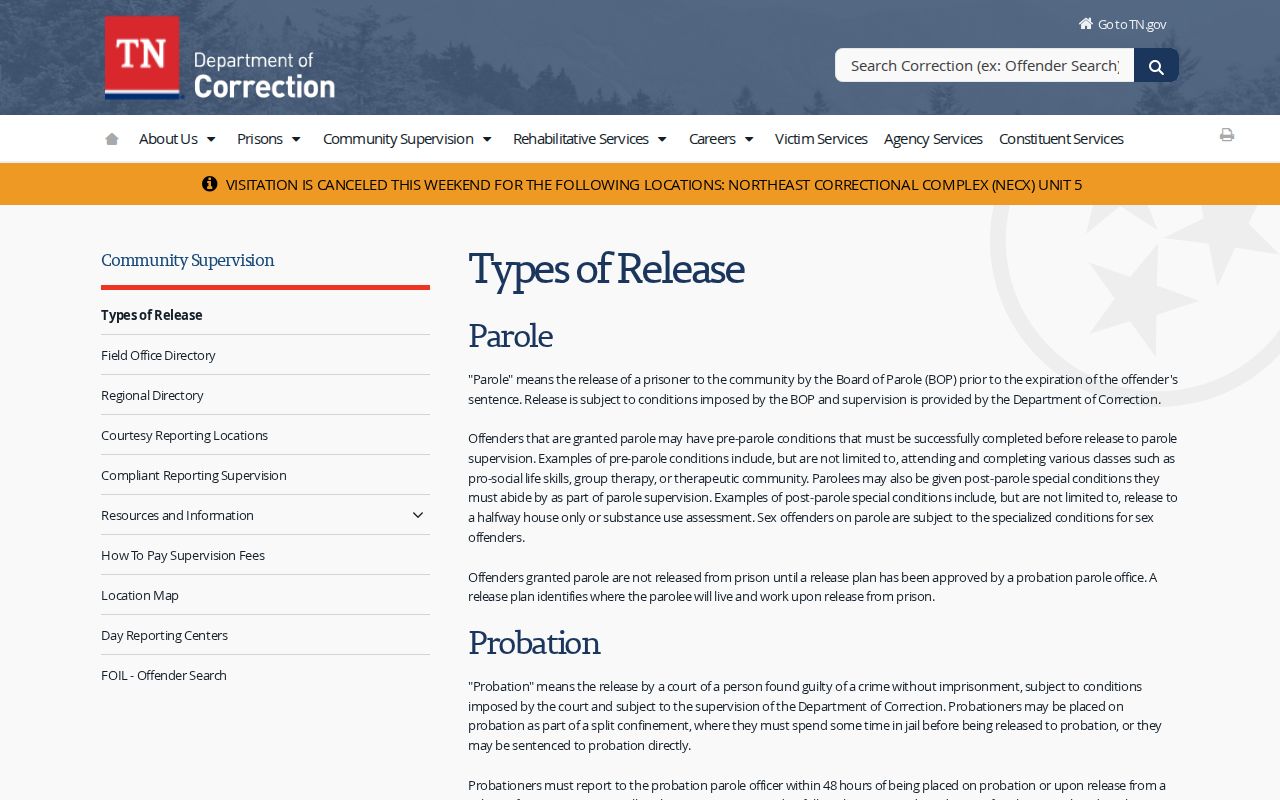
Those categories explain why a custody end date, supervision status, and sentence end date can point to different events.
Tennessee Release Record Fields
A useful release record identifies the person, the event, and the agency that authorized it. At county level, a closed booking may show a booking or inmate number, arrest and booking dates, charges, bond, release date, release reason, and the jail. Available fields differ by sheriff. TDOC's statewide FOIL detail uses sentence and supervision fields instead. It may include name, birth date, TDOC or TOMIS number, SID, aliases, a photo, assigned location, supervision status, offense, sentence dates, parole milestones, and active Tennessee sentences.
| Field | What It Can Establish |
|---|---|
| Identity and agency ID | Matches the record through name, birth date, booking number, TDOC/TOMIS number, or SID. |
| Release type and date | States how and when one custodian ended confinement when the source publishes those fields. |
| Releasing facility | Identifies the jail or prison that completed the release or transfer. |
| Supervision Status | Shows incarcerated, parole, probation, or inactive examples in the TDOC system. |
| Assigned Location | Gives context for current prison placement or community supervision. |
| Release Eligibility Date | Marks a statutory eligibility point, not a promised exit date. |
| Sentence End Date | Marks the sentence expiration endpoint, not necessarily the day of physical release. |
| Parole Hearing Result | Records a Board milestone; a grant may still require programs and an approved release plan. |
The FOIL public detail template displays the state system's exact field structure.
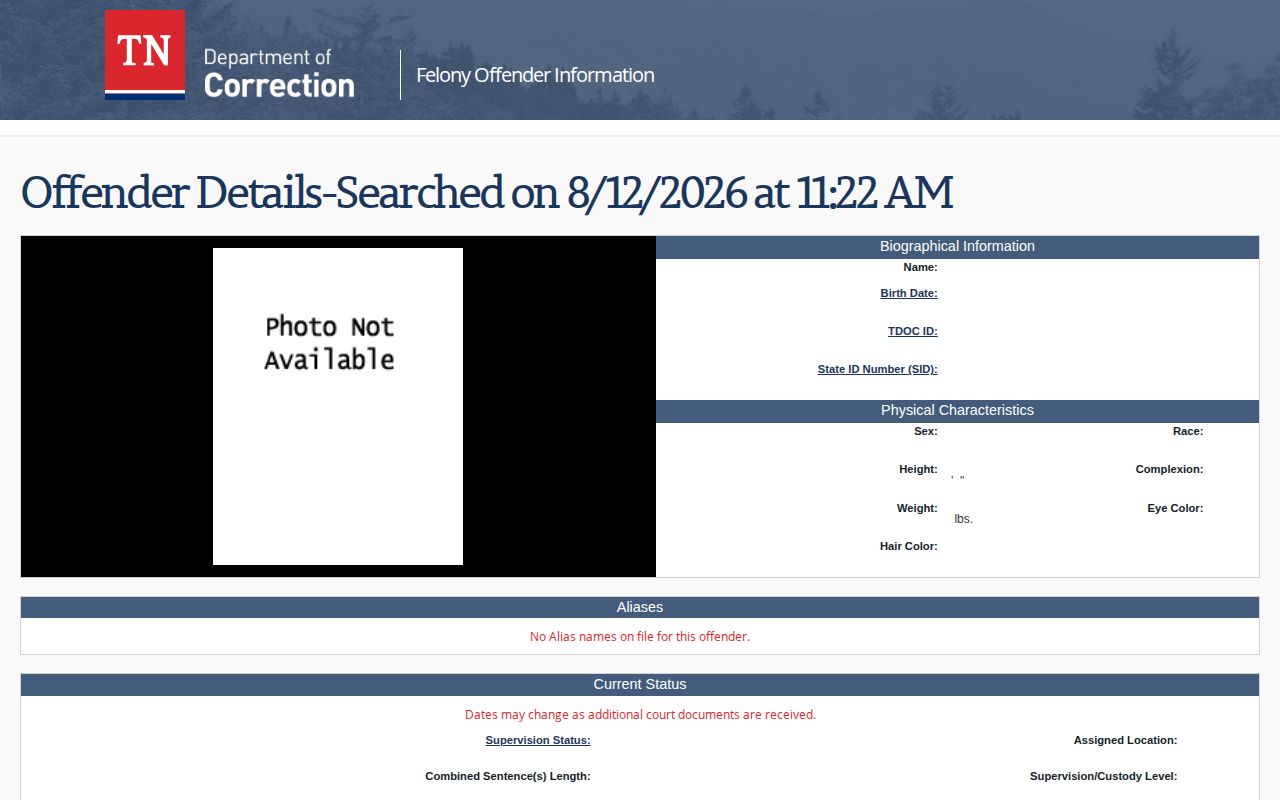
Reading status, location, sentence dates, and active sentences together is safer than treating any one date as final proof.
Tennessee Release Paperwork Has Distinct Dates
TDOC Policy 511.03 gives Tennessee a concrete reason to keep release terms separate. Its victim-release notice records the person's name and TDOC ID, conviction date and county, offense, type and date of release, sentence-expiration date, and intended city and state. The form treats release type, release date, and sentence expiration as separate facts. A detainer release can also send the person to another custodian, so leaving a prison does not prove entry into the community.
The official TDOC release-procedures policy is the source for those distinct form fields and institutional steps.
A formal request should name the document needed. Useful descriptions include a release authorization, release certificate, date and type of release, sentence-computation record, discharge document, or a dated institutional record. “Discharge” means the relevant custody or supervision authority has ended. It is not a synonym for parole, which continues supervision, or transfer, which changes custodians. The releasing institution also completes checks involving authorization, notice, property, trust funds, identification, certificates, and transportation procedures.
Can a roster disappearance prove release? No. It is only a prompt to check a closed booking, FOIL, the next possible custodian, and the court order behind the change.
Note: Tennessee research found no reliable current official source for one universal gate-money amount, so any amount must be confirmed with the institution.
Request Tennessee Release Records
Tennessee has no central public-records warehouse. Send a request to the office that keeps the record. A sheriff or jail administrator holds a county booking and release record. TDOC holds prison, sentence, and state release records. The Board of Parole holds its hearing files. A county court clerk holds a trial judgment, bond order, dismissal, or other disposition. No single fee or fulfillment time applies across all custodians; use the agency's current policy and response notice. The Tennessee County Directory routes a local request to the correct county rather than sending every inquiry to TDOC.
- Identify the custodian from the last confirmed jail, prison, court, or supervision record. Include the county and a narrow date range.
- Give the person's full name, known booking or TDOC/TOMIS number, date of birth, and a precise description of the release document.
- Follow that custodian's public-records policy. Its form, proof rules, fees, and delivery method may differ from those of another Tennessee agency.
- For old TDOC material, use the archived-record portal or mail Records Management at the Rachel Jackson Building, 2nd Floor, 320 6th Avenue North, Nashville, TN 37243-0465.
- Do not prepay an archive-search charge. TDOC says it will notify the requester of charges after the search is complete; records questions may be directed to 615-253-8079.
The TDOC Archived Record Request page shows both the online and mail routes.
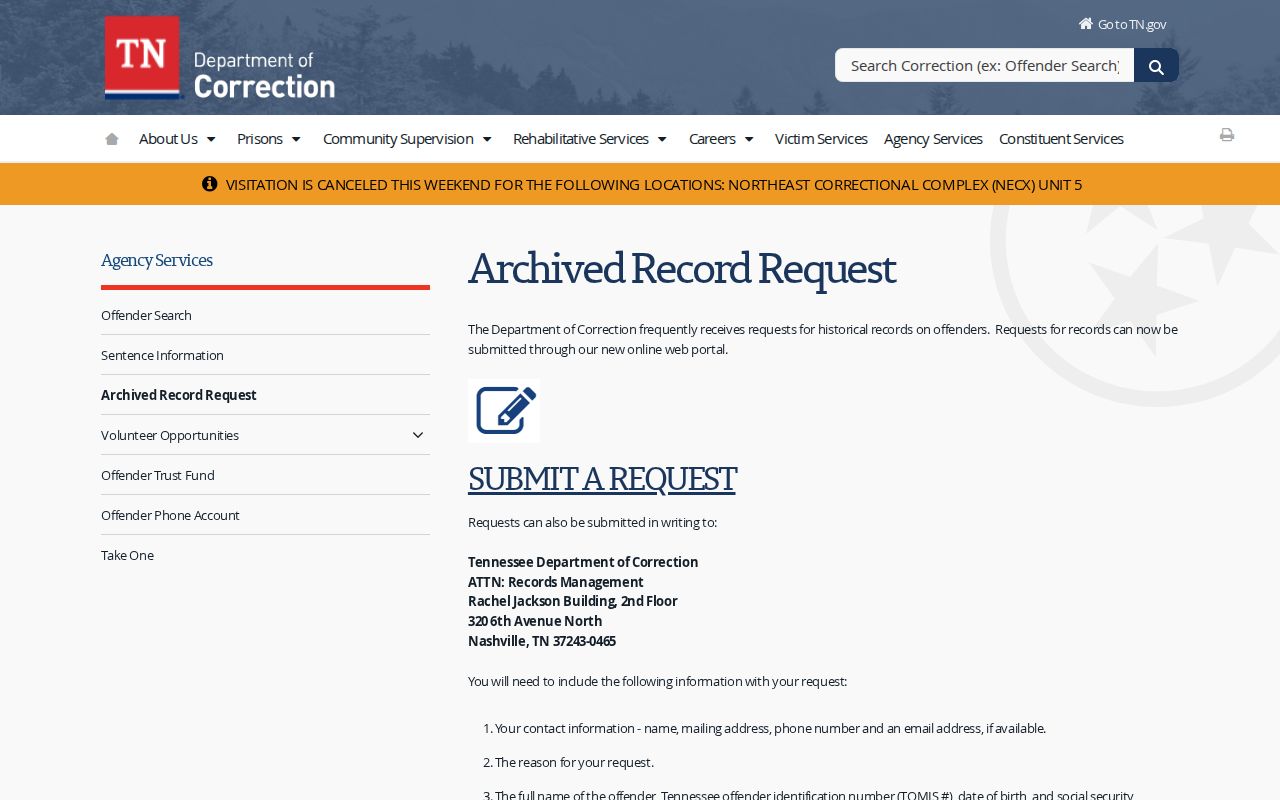
Former records remain within FOIL's stated scope, but TDOC publishes no universal online retention period; older detail may require this archive process.
Tennessee Release Records Law
The Tennessee Public Records Act, principally Tenn. Code Ann. § 10-7-503 and following sections, opens nonexempt state, county, and municipal records to inspection by Tennessee citizens during business hours. The law also sets a response process. It does not merge records into one portal. Each custodian publishes its own policy, and exemptions or redactions may protect confidential parts of a file even when a basic release fact is available.
Key records rule: Tenn. Code Ann. § 10-7-503 supplies the general inspection and response framework. The Office of Open Records Counsel explains why requests go to the actual custodian.
Sealed or expunged matters require care. An expungement is a court-authorized process affecting qualifying records; it does not justify guessing that every agency copy or old online image has vanished. Juvenile photographs have separate confidentiality limits. Adult booking photos remain subject to the records law, record-specific exemptions, court orders, and local policy. Research found a 2021 Tennessee bill proposal about digital mugshot removal, but no enacted statewide anti-pay-to-remove law. A proposal must not be cited as current law.
Tennessee Release Counts Need Context
The Tennessee Board of Parole issued 2,448 parole release certificates during fiscal year 2024-25. That is an annual output for one release path. It is not the total number of Tennessee prison or jail releases. Expiration, determinate release, court orders, pardons, deaths, transfers, and local jail departures follow other paths. The same fiscal-year report recorded 736 parole appeal applications and 254 added victim or family registrations for hearing, decision, and release notice.
TDOC's latest published statewide snapshot counted 59,915 people on probation, 11,717 on parole, and 3,372 in Community Corrections as of June 30, 2025. Those published groups total 75,004, but that roll-up is a point-in-time supervision stock. It does not measure exits during a year. The 11,717 parole figure and 2,448 certificates therefore answer different questions. Older annual material used a different displayed counting frame, so a claimed year-over-year percentage would be unsafe without reconciling the underlying definitions.
The Board's FY 2024-25 report supplies the certificate count, while the TDOC Statistical Abstract supplies the June 30, 2025 supervision counts.
Note: A Tennessee release count is meaningful only when its agency, time period, population, and release category are stated together.
Find Tennessee Released Inmates
Start with the last known custody layer. FOIL is the main statewide check for a current or former TDOC felony offender. It is not a universal county jail list. A local booking with no TDOC history belongs with the sheriff, jail records custodian, and trial clerk. Federal prison and immigration custody require their own locators. This sequence also avoids treating the first same-name result as the correct person.
- Decide whether the last confirmed custodian was a Tennessee county jail, TDOC prison, federal prison, or ICE facility.
- For a state felony sentence, search FOIL by TDOC/TOMIS number when known. Otherwise use the committed name and date of birth, then compare all identifiers.
- For a county jail, check that county's official current and recent-release channels. Request the closed booking when the public roster no longer shows the person.
- Read the court disposition when bond, dismissal, sentence credit, revocation, or a court order may explain the custody change.
- Check BOP or ICE when a federal sentence or detainer is possible. Use Tennessee SAVIN for alerts, but keep the underlying agency record as proof.
Important: A missing jail entry does not prove community release. Transfer, data lag, name variation, or another custodian may explain the change.
TDOC Search for Tennessee Releases
Felony Offender Information Lookup, called FOIL, covers felony offenders who are currently or formerly in TDOC custody or supervision. Search by the stable TDOC/TOMIS number if possible. With a name search, compare birth date, SID, aliases, physical descriptors, and photo when present. FOIL says a photo may be included, so no photo does not mean no record. MyTN also reaches FOIL through its Public Safety area, but it is another interface to the same statewide subject.
The TDOC Offender Search gateway explains FOIL's current-and-former scope and links the companion state systems.
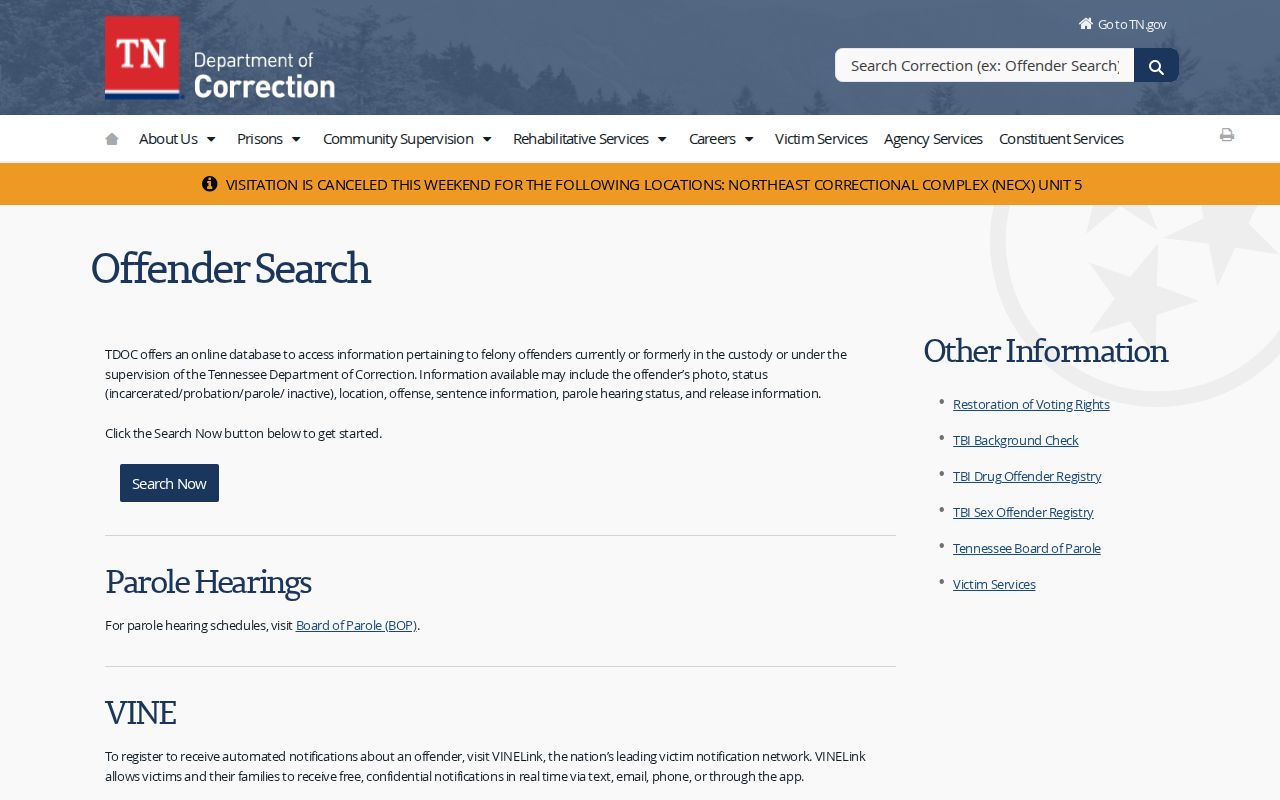
That scope makes FOIL strong for former state felony cases but too narrow for many misdemeanor, pretrial, and purely local releases.
Open the matching detail and read Supervision Status with Assigned Location. Incarcerated, probation, parole, and inactive are possible status examples. Then compare Sentence Begin Date, Sentence End Date, Release Eligibility Date, Parole Hearing Date, Parole Hearing Result, and Active Tennessee Sentences. “No active Tennessee sentences on file for this offender” supports a former-case conclusion. It does not rule out county, federal, immigration, or out-of-state custody.
Tennessee County Release Feeds Differ
Tennessee's 95 counties do not publish one uniform local release feed. Some sheriffs provide only a current roster. Some add booking or recent-release views. Others route record requests through a phone, form, email, or records coordinator. A current roster usually answers who remains in custody, not who left yesterday. Once a name drops away, the closed booking, release log, court order, and records request become more useful.
FOIL cannot fill every county gap because its scope centers on Tennessee felony offenders with TDOC custody or supervision history. A person released after a misdemeanor booking, bond, time served, or dismissal may never have a FOIL entry for that event. County research must control the route. The directory sends a reader to the sheriff and records system for the county that actually held the person.
Why is a released person gone from the roster? Live rosters are built to describe current custody. The absence should trigger a release-record check, not an unsupported conclusion.
Tennessee Release Supervision and Alerts
Release and discharge are not the same. Parole places a person in the community before sentence expiration under Board conditions and TDOC supervision. Probation is court-ordered community supervision. Community Corrections is a separate court-ordered alternative managed through the state system. Mandatory reentry supervision may apply during the final part of a qualifying sentence. FOIL's Supervision Status and Assigned Location help distinguish those states from inactive status.
Tennessee SAVIN, delivered through VINELink, provides notices about TDOC location, custody changes, transfers, sentence expiration, release, and parole eligibility. Search by name or TOMIS number, confirm the person and custodian, then register for phone, email, TTY, text, or available app notices. Support is available around the clock at 888-868-4631. Registration is an alert service, not a certified release record. County data timing depends on the contributing custodian.
The Tennessee Board of Parole hearings hub is the official schedule entry point.

A favorable hearing result is only a milestone because programs, a release plan, and a parole certificate may still precede physical release.
Tennessee Federal Release Checks
Use the Federal Bureau of Prisons locator for a federal sentence. Search by a BOP register number, formatted as five digits, a hyphen, and three digits, or search by name. Results may include name, register number, age, race, sex, release date, and location. A past date with no facility can mean the person was released and is no longer in BOP custody. “Released” or “Not in BOP Custody” still does not rule out supervised release or another agency's custody. Online BOP records mainly cover federal releases after 1982.
The BOP Inmate Locator is the proper federal source rather than Tennessee FOIL.
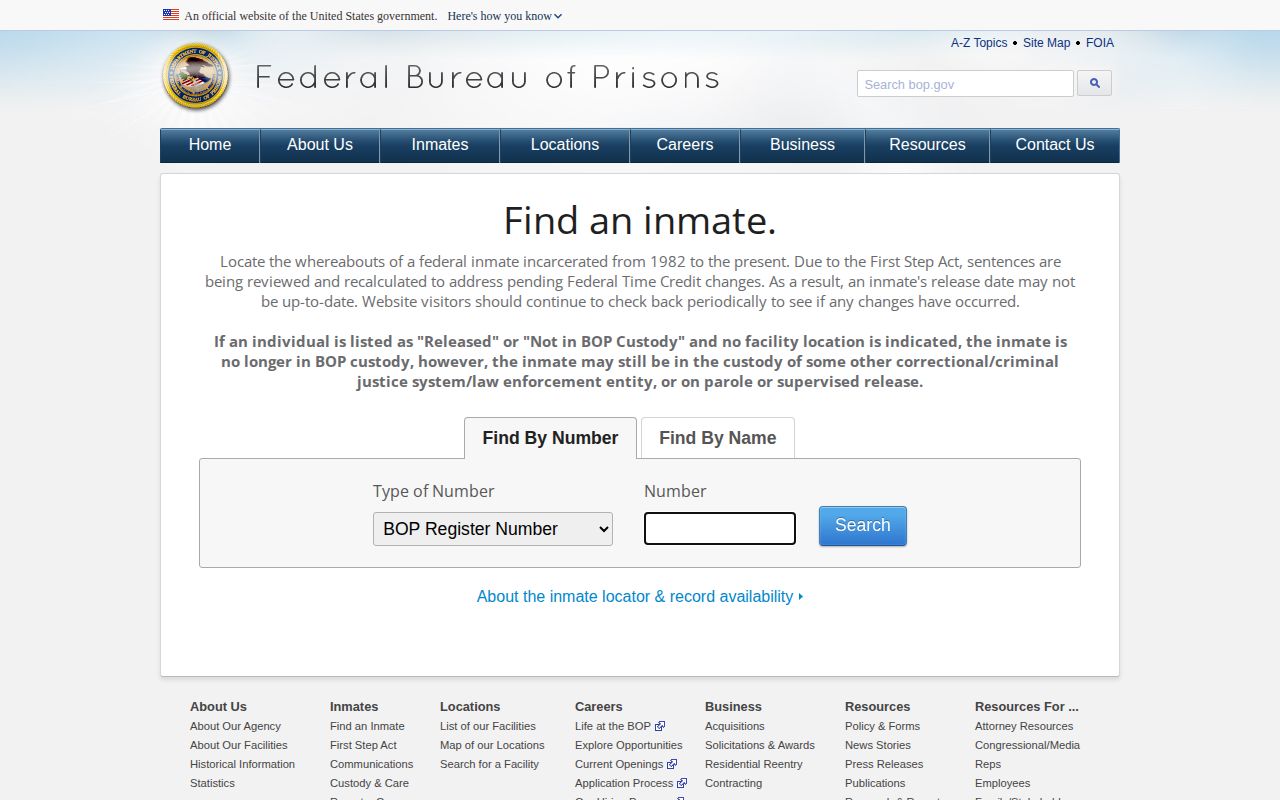
Its displayed release date must be read with BOP's warning that recalculations can make a projected date temporarily out of date.
Use ICE's detainee locator after a detainer or immigration transfer. Search with a nine-digit A-number and country of birth, adding leading zeroes when needed, or use exact name and country of birth. ICE says the tool covers present custody and releases within the prior 60 days, with exclusions and processing limits. A failed search is not proof of community release. Minors do not appear, and safety or agency discretion can also limit a result.
Tennessee Released Versus In Custody
Each system answers a narrow question. Match the record to the custody layer, then corroborate uncertain results with the releasing agency or court. A date labeled eligibility is not actual release. A sentence end is not always the prison exit date. An inactive state record does not clear every other custodian.
| System | Best Use | Main Limit |
|---|---|---|
| County jail roster | Current local custody | A released person often drops off; it may not show the closed booking. |
| County release record | Local release date, reason, booking, and jail | Access and fields vary among Tennessee counties. |
| TDOC FOIL | Current or former Tennessee felony custody and supervision | Not every county booking; no promised universal physical Release Date field. |
| Tennessee SAVIN | Custody and release alerts | Timing depends on the contributing custodian; alerts are not formal proof. |
| BOP locator | Federal custody and release date | Federal-only coverage, mainly for releases after 1982. |
| ICE locator | Current ICE custody or a recent ICE release | Limited recent window and stated exclusions. |
| Court clerk | Order or judgment behind the release | Trial records remain county by county. |
Note: Verify identity with more than a name, especially when several people share common names or a record uses an alias.
Tennessee Release Orders Stay Local
Tennessee Public Case History sounds like a full statewide court database, but its coverage is appellate. It includes the Supreme Court, Court of Appeals, and Court of Criminal Appeals. Users can search by appellate case number, case style, party name, or organization. Appeals whose record was filed after September 1, 2006 are included, and many appellate motions, orders, judgments, and opinions filed after August 26, 2013 are available. Data is current through the prior business day.
The Tennessee appellate Public Case History portal illustrates that statewide but limited scope.
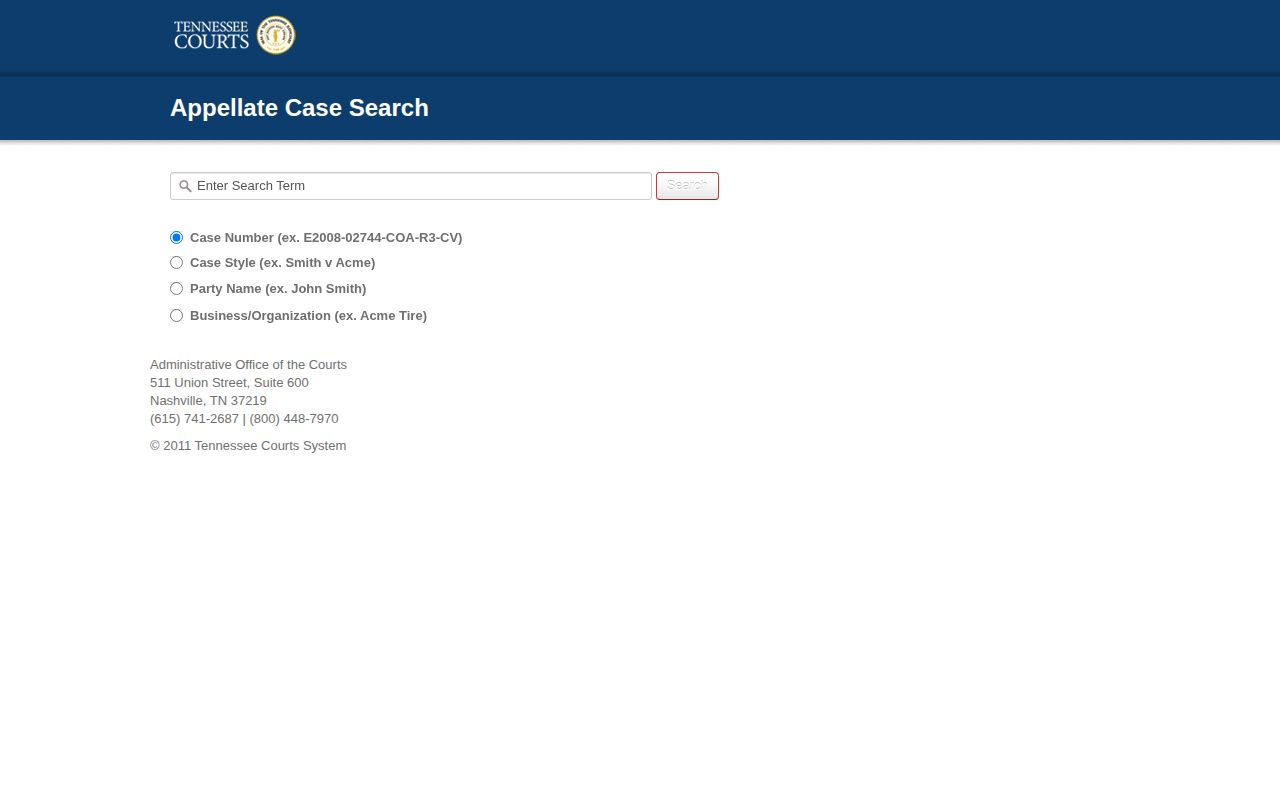
A name absent there may still have a trial criminal case because bond orders, dismissals, revocations, and judgments often remain with the county clerk.
That split matters most when a court action caused release. The county trial clerk can hold the order that FOIL or a jail status cannot explain. Search the appellate portal only when the case reached one of its covered courts. Otherwise, identify the filing county and ask its clerk for the relevant disposition. A court record explains legal authority; the jail or prison release record confirms how the custodian acted on it.
Tennessee Release Facilities Span Systems
Tennessee releases and transfers occur through county jails, local corrections centers, TDOC prisons, privately managed state facilities, federal prisons, and immigration detention sites. Some state-sentenced people remain in county jails. Separate annexes or work centers remain distinct release points when local records treat them that way. Juvenile-only sites fall outside the adult directory.
The Tennessee Facility Directory identifies the correct layer and locality for each researched facility. It distinguishes facilities with dedicated local coverage from those listed for statewide completeness. That separation prevents a transfer from being mislabeled as freedom and sends each records request to the office that can answer it.